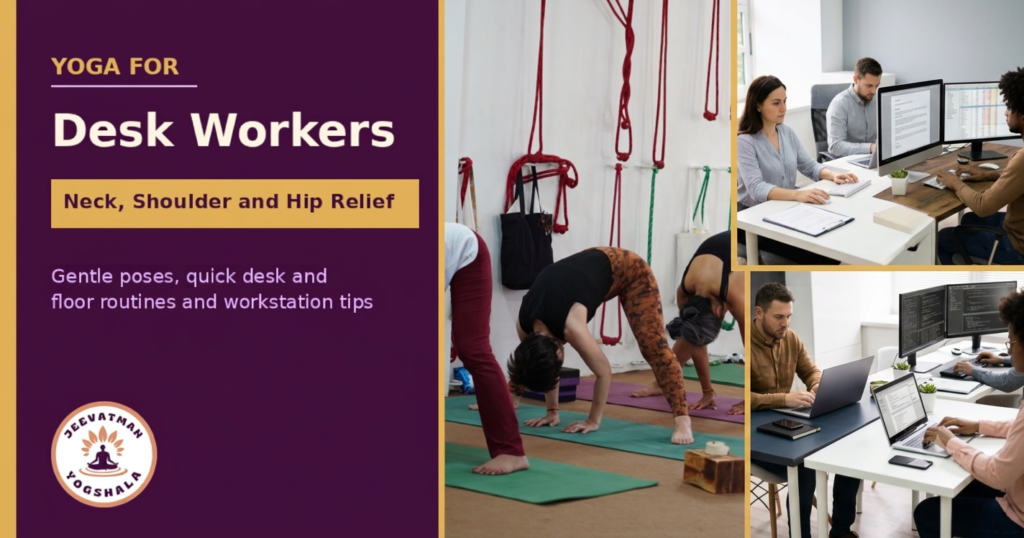
Quick Answer: Yoga for desk workers means short, gentle movement breaks that ease the stiffness of long hours sitting. Good options include seated neck stretches, shoulder rolls, eagle arms, a seated twist, a seated figure-4 hip stretch, a low lunge and a standing forward fold. Aim for five to ten minutes a few times a day, move within a comfortable range, and combine yoga with regular breaks and a sensible workstation set-up. Yoga may relieve stiffness but is not a treatment, so see a doctor if pain persists or you feel numbness or tingling.
By mid-afternoon, your neck feels tight, your shoulders have crept up toward your ears and your hips feel as if they have been locked in the same position for hours. If that sounds familiar, you are not alone, and you do not need an hour-long class or a special studio to feel better.
This guide shares yoga for desk workers in plain language: ten gentle poses for the neck, shoulders, spine and hips, a quick routine you can do at your chair, a longer one for after work, and simple workstation tips. It is general information, not medical advice.
Important Distinction: Yoga can ease the stiffness that comes from sitting for long periods, but persistent pain, numbness, tingling or weakness needs a medical assessment. Do not try to stretch through pain, and see a doctor if symptoms continue.
Why Desk Work Leaves You Stiff
Sitting in one position for hours, often with your head forward and your shoulders rounded toward the screen, can leave muscles feeling tight and tired. Your hips stay bent for long periods, and your body gets little variety of movement.
Workplace safety guidance supports this. The US Occupational Safety and Health Administration describes neutral working postures, with the head balanced over the torso, shoulders relaxed, elbows bent between 90 and 120 degrees and feet supported, and advises changing position frequently and taking short breaks; see its computer workstation guidance. Yoga breaks fit naturally into that advice, which is why yoga for desk workers focuses on short, frequent movement.
Before You Start: Simple Ground Rules
- Move gently: stretch to a mild, comfortable pull, never to pain.
- Breathe slowly: longer out-breaths help tense muscles let go.
- Go slowly: avoid jerky or bouncing movements, especially in the neck.
- Little and often: short breaks through the day usually help more than one long session.
- Stop if something feels wrong: sharp pain, dizziness, numbness or tingling are signs to stop.
If you are new to yoga, our guide to easy yoga poses and meditation tips for stress relief is a gentle, desk-job-friendly place to start.
10 Gentle Poses: Yoga for Desk Workers
Neck Relief
1. Seated Side Neck Stretch
Sit tall with your shoulders relaxed. Slowly tilt your right ear toward your right shoulder until you feel a mild stretch along the left side of your neck. Keep your left shoulder soft and hold for several slow breaths, then change sides. Do not pull on your head with your hand, and do not force the movement.
2. Gentle Chin Tuck
Sit tall and look straight ahead. Gently draw your chin straight back, as if making a small double chin, so your head glides back over your shoulders. Hold for a breath or two and release. Repeat a few times. This is a small, gentle movement, so keep it comfortable and stop if you feel any pain.
Shoulder and Upper Back Relief
3. Shoulder Rolls
Lift your shoulders toward your ears as you breathe in, then roll them back and down as you breathe out. Repeat slowly for five to eight rounds, then reverse the direction. Let your arms hang heavy and your neck stay long.
4. Eagle Arms (Garudasana Arms)
Extend your arms forward, cross your right arm over your left and bend your elbows, wrapping your forearms if you can, or simply hugging yourself. Lift your elbows slightly and drop your shoulders. Hold for a few breaths, then switch sides. It stretches the upper back and the area between the shoulder blades.
5. Seated Cat-Cow (Marjaryasana-Bitilasana)
Place your hands on your knees. As you breathe in, lift your chest and gently arch your back; as you breathe out, round your spine and draw your chin toward your chest. Move slowly for six to eight rounds. It mobilises the whole spine and links movement with breath.
Spine and Hip Relief
6. Seated Twist
Sit tall near the front of your chair. Place your right hand on the outside of your left knee and your left hand on the back of the chair or the seat. Breathe in to lengthen your spine and breathe out to turn gently to the left. Hold for a few breaths, then change sides. Twist from the middle of your back, not by yanking with your arms.
7. Seated Figure-4 (Chair Pigeon)
Sit tall and place your right ankle on your left thigh, just above the knee, with your right foot flexed. Keep your spine long and, if you want a deeper stretch, hinge forward slightly from your hips. Hold for five to eight breaths, then switch sides. It stretches the outer hip and glutes. Skip it, or go very gently, if you have knee or hip pain.
8. Low Lunge (Anjaneyasana)
From standing, step your right foot back and lower your back knee to a folded blanket or mat, with your front knee over your ankle. Lift your chest and gently sink your hips forward to stretch the front of the hip. Hold for five to eight breaths, then switch sides. Keep your front knee comfortable and your lower back long.
9. Standing Forward Fold (Uttanasana)
Stand with your feet hip-width apart, bend your knees generously and fold forward from your hips, letting your head and arms hang heavy. Hold for several slow breaths and roll up slowly. If you have high or low blood pressure, dizziness or eye pressure concerns, keep your head higher or skip it. See our guide on Janu Sirsasana for another forward fold that eases tight hamstrings.
10. Child's Pose (Balasana)
Kneel on the floor, bring your big toes together and sit back toward your heels. Fold forward and rest your forehead on the floor or a cushion, with your arms long or by your sides. Stay for several slow breaths. Place a cushion between your hips and heels if your knees feel tight.
Practical Tip: Keep a spare cushion or folded blanket near your desk. It makes the low lunge and Child's Pose more comfortable, and having props to hand makes you more likely to take the break.
Quick Reference: The 10 Poses at a Glance
| Pose | Area | Suggested Time |
|---|---|---|
| Seated Side Neck Stretch | Neck | Several breaths each side |
| Gentle Chin Tuck | Neck | A few gentle repetitions |
| Shoulder Rolls | Shoulders | 5 to 8 rounds each way |
| Eagle Arms | Upper back and shoulders | A few breaths each side |
| Seated Cat-Cow | Spine | 6 to 8 slow rounds |
| Seated Twist | Spine and back | A few breaths each side |
| Seated Figure-4 | Outer hips and glutes | 5 to 8 breaths each side |
| Low Lunge | Front of the hips | 5 to 8 breaths each side |
| Standing Forward Fold | Hamstrings and back | Several slow breaths |
| Child's Pose | Back, hips and shoulders | Several slow breaths |
Yoga for Desk Workers: A 5-Minute Reset at Your Chair
- Shoulder rolls: about 30 seconds
- Seated side neck stretch: about 30 seconds each side
- Eagle arms: about 30 seconds each side
- Seated cat-cow: about 45 seconds
- Seated twist: about 30 seconds each side
- Seated figure-4: about 45 seconds each side
Try this reset a couple of times a day, for instance mid-morning and mid-afternoon.
Yoga for Desk Workers: A 10-Minute Floor Reset After Work
- Standing forward fold for one minute
- Low lunge for about two minutes, one minute each side
- Child's Pose for two minutes
- Seated cat-cow or hands-and-knees cat-cow for one minute
- Seated twist for about two minutes, both sides
- Rest for a minute or two with slow breaths
For a longer wind-down at the end of the day, see our guides on yoga for sleep and yoga for mental health. For a flowing warm-up, try Surya Namaskar (Sun Salutation).
Small Changes at Your Desk That Help
Yoga for desk workers works best alongside a comfortable workstation and regular movement.
- Keep the top of your screen at or just below eye level so your head stays balanced over your torso.
- Keep your shoulders relaxed and your elbows close to your body, bent at a comfortable angle.
- Support your feet on the floor or a footrest.
- Change position often, stand up, walk and take short breaks.
- Use reminders, a timer or a habit such as stretching after each meeting.
To build overall strength and fitness, read our guide on how to be fit with yoga, and for tight muscles elsewhere see muscle pain relief with asana and yoga poses for back pain.
Who Should Take Extra Care
Check with a doctor or qualified teacher before starting, or adjust the practice, if you:
- have a neck, spine, disc, shoulder or hip injury or condition
- have had recent surgery or have a hip or knee replacement
- feel numbness, tingling or weakness in your arms or legs
- have high or low blood pressure, dizziness or eye pressure concerns
- are pregnant or managing another health condition
The National Center for Complementary and Integrative Health notes that yoga is generally considered safe for healthy people when practised appropriately, that you can get hurt, and that learning from a qualified instructor can lower your risk. Stay within comfortable limits, skip any pose that causes pain and see a professional for personalised advice.
Common Mistakes to Avoid
Watch out for these frequent errors:
- Stretching into pain instead of a mild, comfortable pull
- Jerking or rolling the neck quickly
- Holding your breath during stretches
- Doing everything in one long session, then not at all for days
- Ignoring workstation set-up and relying on yoga alone
- Pushing through numbness, tingling or sharp pain
When to See a Doctor
See a doctor if neck, shoulder, back or hip pain persists, gets worse, spreads to your arms or legs, or comes with numbness, tingling, weakness or severe headaches, or if it follows an injury. Yoga is a helpful habit for stiffness, but it is not a substitute for assessment of ongoing symptoms.
For Employers and Yoga Teachers: Workplace Yoga
Short desk-friendly classes can be a welcome part of workplace wellbeing. If you teach, keep sessions gentle, offer chair options and avoid health claims. Our guide on how to start a yoga class covers setting the tone from the first minute, and you can learn how to sequence classes safely in our 200-hour yoga teacher training in Rishikesh.
If you are craving more than a lunchtime stretch, see our comparison of a yoga retreat vs teacher training to decide what kind of break suits you.
Frequently Asked Questions
What are the best yoga poses for desk workers?
How often should desk workers do yoga?
Can yoga help with neck pain from sitting?
Can I do yoga at my desk?
Does yoga fix posture?
How long should I hold desk stretches?
Is yoga good for lower back pain from sitting?
Do I need to change into yoga clothes?
When should I see a doctor about desk-related pain?
Key Takeaway
Yoga for desk workers works best as little and often: a few gentle neck, shoulder, spine and hip stretches through the day, plus regular breaks and a comfortable workstation. Move within a mild, comfortable range, breathe slowly, and see a doctor if pain, numbness or tingling continues. A few minutes of movement can make a long day at the desk feel lighter.
Want to Learn Yoga Properly?
If you would like guided, step-by-step learning, you are welcome to review the course details and ask any questions about what the training covers. Take your time and choose what fits your goals.
Explore the 200-Hour Course DetailsThis article is general information, not medical advice. Yoga is not a treatment for pain or any medical condition. If you have persistent pain, numbness, tingling, an injury or health concerns, please speak to a qualified healthcare professional before starting a new practice.