Quick Answer: The biggest of all yoga myths is that you need to be flexible to start. You do not. Flexibility is something regular yoga can help you build over time, not an entry requirement. Yoga is also about strength, balance, breath and focus, and props and modifications let almost any body practise comfortably. Start where you are, move gently without forcing, and check with a doctor or teacher first if you have an injury or health condition.
"I can't do yoga. I can't even touch my toes." It is one of the most common things people say when they are asked to try a class, and it is based on one of the most persistent yoga myths. It is a bit like saying you cannot take a shower because you are dirty. Yoga is for exactly the stiff, tight and tired.
In this guide we bust the biggest yoga myths, starting with flexibility, and explain what yoga really asks of you, how to adapt poses to your body, and how to begin if you are not flexible. It is general information, not medical advice.
Important Distinction: Flexibility, mobility and strength are not the same. Flexibility is how far a muscle can lengthen. Mobility is how well you can control movement through a joint's range. Strength and stability help you support that movement. Yoga can work on all three, and you do not need a lot of any of them to begin.
Yoga Myth 1: You Need to Be Flexible to Do Yoga
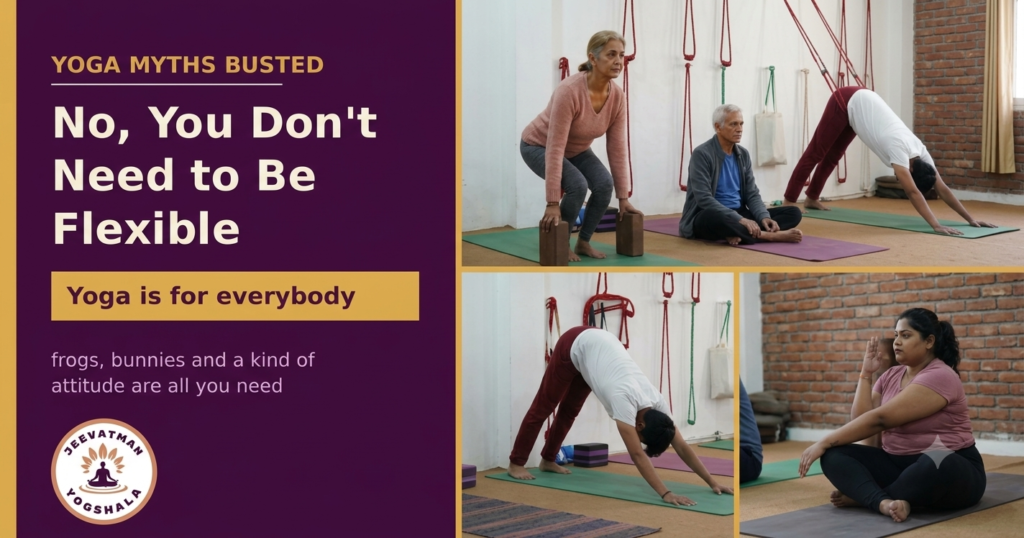
This is the headline myth, and it is simply not true. You do not need to be flexible to do yoga. Yoga is the practice, and flexibility is one of many things it may develop. Asking whether you are flexible enough for yoga is like asking whether you are fit enough to start exercising.
Why this is one of the most common yoga myths
Social media and magazine photos tend to show people in dramatic, deep poses, so it is easy to assume that is what yoga looks like. But those images show the extreme end of one kind of practice. Most real classes are filled with people of every level, using props, bending their knees and taking things slowly.
What yoga actually asks of you
Yoga asks you to turn up, breathe, pay attention and move within your own range. A pose is not a test of how far you can stretch. It is a way to explore sensation, build awareness and find steadiness, whatever shape your body makes.
Why some bodies do not reach certain shapes, however much they stretch
How far you can go in a pose depends on more than muscle tightness. The shape of your bones and joints, the length of your limbs, past injuries and your body's natural structure can all limit certain positions. Two people can practise equally well and look completely different in the same pose. This is one more reason not to need to be flexible in a particular way.
Props and modifications make yoga accessible
| Pose | Common Struggle | Simple Modification |
|---|---|---|
| Forward Fold | Tight hamstrings, cannot reach the floor | Bend your knees, or rest your hands on blocks or a chair |
| Seated poses (Easy Pose) | Tight hips, knees higher than hips | Sit on a cushion or folded blanket |
| Downward-Facing Dog | Tight hamstrings or shoulders | Bend your knees and keep your spine long |
| Triangle Pose | Cannot reach the floor | Rest your hand on a block or your shin |
| Seated Forward Fold | Cannot reach your feet | Use a strap and keep your knees bent |
| Child's Pose | Knees or hips feel tight | Place a cushion between hips and heels or under your forehead |
For an example of a gentle forward bend, see our guide to Janu Sirsasana, with its benefits and precautions, which includes tips for tight hamstrings.
Flexibility often improves with practice
Many people notice that they feel looser over time with regular practice, though how quickly varies a great deal and is not guaranteed. Treat any gain as a pleasant side effect, not the goal, and never force a stretch to speed it up.
Key Takeaway: You do not need to be flexible for yoga. Start with the body you have today, use props, move gently and let flexibility, if it comes, arrive as a by-product.
Yoga Myth 2: Yoga Is Just Stretching
One of the most repeated yoga myths is that yoga is just stretching. Stretching is part of yoga, but it is not the whole story. Many poses build strength, balance, endurance and body awareness, and yoga also includes breathing and meditation. The NHS lists yoga as an example of a muscle-strengthening activity in its physical activity guidelines for adults, alongside activities such as carrying heavy shopping and lifting weights.
To see how yoga can fit into an active routine, read our guide on how to be fit with yoga.
Yoga Myth 3: Yoga Is Only for Young, Thin or Female People
Of all the yoga myths, this one keeps many people away, yet yoga is for every body. People of all ages, sizes, genders and abilities practise it, and good teachers offer variations to suit different needs. If you worry that you are too old, too heavy, too stiff or too unfit, you are in good company.
If you are wondering about age in relation to teaching, read our guide on whether you are too old for yoga teacher training, and see whether a complete beginner can do a 200-hour yoga teacher training.
Yoga Myth 4: You Have to Be Spiritual or Religious
Yoga has deep spiritual roots, and some people are drawn to those teachings. But you can also practise for movement, stress relief, strength or simply to feel better, without adopting any belief. If you are curious about the traditional side, our guide to Nada Yoga, the ancient yoga of sound is a gentle introduction, and it is always fine to take what you find useful.
Yoga Myth 5: No Pain, No Gain
Like many yoga myths, this one can lead to injury. Discomfort is not a sign of progress. A mild, comfortable stretch is fine, but sharp pain, numbness or tingling is a signal to stop. The National Center for Complementary and Integrative Health notes that yoga is generally considered safe for healthy people when practised appropriately, but that you can get hurt, and that learning from a qualified instructor can lower the risk.
Pushing deeper to look the part is one of the quickest ways to strain a muscle or joint, especially for people who are already very flexible.
Yoga Myth 6: You Must Practise Every Day for an Hour
Short sessions count. Ten minutes a few times a week is a perfectly good start, and many people find that small, regular practices are easier to keep than big commitments. Our guides on yoga for desk workers and yoga for sleep show how a few minutes can fit into a busy day.
Yoga Myth 7: You Need Expensive Gear and a Studio
A mat, or even a carpet, and comfortable clothes are enough to begin. At home, a firm cushion, a belt or scarf and a couple of books can stand in for blocks and straps. Studios and classes are great for guidance, but they are not a requirement.
Yoga Myths at a Glance
| Yoga Myth | The Reality |
|---|---|
| You need to be flexible | Flexibility is something yoga may build, not a requirement |
| Yoga is just stretching | It also builds strength, balance and focus |
| Yoga is for young, thin or female people | Yoga is for every body, with modifications |
| You must be spiritual | You can practise for physical and mental wellbeing |
| No pain, no gain | Sharp pain is a signal to stop, not to push |
| You must practise daily for an hour | Short, regular sessions are enough to start |
| You need expensive gear | A mat and comfortable clothes are enough |
How to Start Yoga If You Are Not Flexible
Now that the yoga myths are out of the way, here is a simple way to begin.
- Pick a beginner or gentle class, and tell the teacher about any injuries or concerns before you begin.
- Use props freely: blocks, straps, bolsters and chairs are tools, not signs of weakness.
- Bend your knees whenever your hamstrings or back feel tight.
- Focus on breath, not on how deep you go.
- Set small goals, such as practising for ten minutes, three times a week.
- Be patient: comfortable progress beats forced progress.
Our guide to easy yoga poses and meditation tips for stress relief offers a gentle starting point, and our yoga for mental health guide shows how yoga can support calm and focus.
Practical Tip: Try a simple 10-minute routine: Cat-Cow, Child's Pose, a gentle seated twist, Reclining Butterfly and a few minutes of Corpse Pose. Every one of these can be done with bent knees and plenty of support, and none requires flexibility.
What If You Are Very Flexible?
Being very flexible does not automatically make yoga easier or safer. People with naturally loose joints, sometimes called hypermobile, may find it easy to sink into deep poses but need to build strength and stability to protect their joints. If that sounds like you, focus on control, engage your muscles and avoid pushing to the end of your range. A doctor or qualified teacher can offer personalised advice.
Who Should Take Extra Care
Check with a doctor or qualified teacher first, and adapt the practice, if you:
- have an injury, joint problem, back or neck condition
- have had recent surgery or a joint replacement
- are pregnant or recently gave birth
- have high or low blood pressure, dizziness or another health condition
- experience sharp pain, numbness or tingling in any pose
Common Mistakes Beginners Make
Watch out for these frequent errors:
- Believing you must be flexible before you can start
- Comparing yourself with people in the room or online
- Forcing a stretch to look like the picture
- Skipping props because they feel like cheating
- Holding your breath in difficult poses
- Giving up after one class that felt hard
For Yoga Teachers: Welcoming Every Body
If you teach, one of the kindest things you can do is dismantle yoga myths in your own class: offer props without fuss, show modifications as equals, and avoid language that praises depth or flexibility. Our guide on how to start a yoga class covers setting the tone from the first minute, and you can learn to teach inclusively in our 200-hour yoga teacher training in Rishikesh.
Frequently Asked Questions
Do you need to be flexible to do yoga?
What are the biggest yoga myths?
Can stiff people do yoga?
Can I do yoga if I can't touch my toes?
Will yoga make me more flexible?
How long does it take to become flexible with yoga?
Is yoga a real workout?
Is yoga only for women?
Do I need to be spiritual to practise yoga?
Key Takeaway
Of all the yoga myths, the idea that you need to be flexible is the most limiting, and it is simply wrong. You can begin exactly as you are, use props, bend your knees, move gently, and let flexibility, if it comes, arrive with time. Yoga is for every body, and the best way to start is with a short, comfortable practice and a kind attitude.
Ready to Start Where You Are?
If you would like guided, step-by-step learning, you are welcome to review the course details and ask any questions about what the training covers. Take your time and choose what fits your goals.
Explore the 200-Hour Course DetailsThis article is general information, not medical advice. If you have an injury, a medical condition or health concerns, or are pregnant, please speak to a qualified healthcare professional and an experienced yoga teacher before starting a new practice.