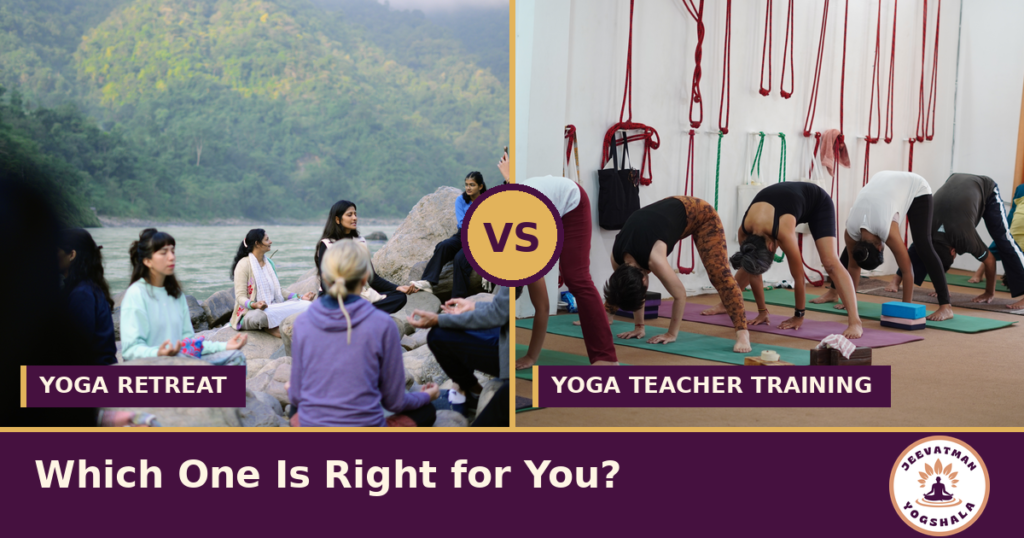
Quick Answer: A yoga retreat is a shorter, flexible stay focused on rest, practice and renewal, with no teaching qualification expected. A yoga teacher training (TTC) is a structured, longer course with a set curriculum, assessments and a certificate, designed to prepare you to teach or to study yoga in depth. Choose a retreat if you want to rest, recharge or try yoga in a new setting. Choose teacher training if you want structured learning, a deeper understanding of yoga, or a path to teaching. Many people do a retreat first, and neither option suits everyone.
If you have been searching for a trip to India or Rishikesh, you have probably seen "yoga retreat" and "yoga teacher training" listed side by side, sometimes by the same school. They look similar from the outside: yoga every day, simple food, a calm setting and people from around the world. It is easy to wonder which one you should actually book.
This guide explains the yoga retreat vs teacher training question in plain language: what each one is, how they differ in time, structure and certificate, who each suits, and what to ask before you book. It is general information, and details differ from one school to another, so always confirm specifics with the school itself.
What Is a Yoga Retreat?
A yoga retreat is a stay, usually at a quiet or scenic location, built around yoga, meditation, rest and simple living. It can last anywhere from a weekend to a couple of weeks or more, depending on the program. The daily schedule is usually lighter and more flexible than a course, with room to rest, explore or simply do nothing.
Retreats are generally open to a wide range of people, including complete beginners, and are usually about your own experience rather than about learning to teach. Content, style and intensity vary, so a retreat at one place can feel very different from a retreat at another. To see how one program is laid out, you can read about our yoga retreat in Rishikesh. A longer example is our seven-day spiritual yoga retreat in Rishikesh.
What a retreat usually offers
- Daily yoga and meditation, often at a gentle or beginner-friendly pace
- Time to rest, reflect and step away from routine
- A relaxed schedule with optional sessions or activities
- A supportive group setting, without exams or assignments
Important Distinction: Most retreats are not designed to qualify you to teach. If you want a teaching qualification, ask the school directly what certificate, if any, is given and what it covers.
What Is Yoga Teacher Training?
A yoga teacher training (TTC) is a structured course. A typical 200-hour yoga teacher training follows a set curriculum that commonly covers areas such as asana practice and alignment, pranayama, meditation, yoga philosophy, anatomy and teaching methodology. Longer programs, such as 300-hour and 500-hour options, go deeper and are usually taken after a foundation course.
Because it is a course, it normally involves a fixed timetable, regular classes, practice teaching, and some form of assessment, followed by a certificate from the school. The exact content, schedule and certificate differ between schools.
A teacher training is also not only for people who want to teach. Many students enrol to deepen their own practice and understanding, with no plan to lead classes. If you are weighing the investment, you may also want to read is yoga teacher training worth it, and see the daily schedule of a 200-hour training to know what to expect.
Yoga Retreat vs Teacher Training: Side-by-Side Comparison
| Point of Comparison | Yoga Retreat | Yoga Teacher Training (TTC) |
|---|---|---|
| Main purpose | Rest, renewal, personal practice | Structured learning and, for many, preparing to teach |
| Typical length | Short: from a weekend to a couple of weeks or so | Longer: usually several weeks for an immersive course |
| Daily schedule | Lighter and more flexible | Fixed timetable with classes and practice |
| Curriculum | Usually informal and varies widely | Set curriculum across practice, theory and teaching skills |
| Assessment | Usually none | Commonly includes practice teaching and an assessment |
| Certificate | Usually none, or an attendance note | A course certificate issued by the school; ask what it states |
| Best suited to | Beginners, people needing a break, those exploring yoga | Those wanting depth, structure or a path to teaching |
| What to check before booking | Schedule, style, level, accommodation, cancellation policy | Curriculum, lead teachers, certificate details, cancellation policy |
The Key Differences Explained
Purpose and expectations
A retreat asks little of you apart from showing up and being open to the experience. A teacher training asks for commitment: attending sessions, studying, practising and, in many programs, being assessed. Neither is better; they simply ask different things of you.
Time and intensity
A retreat can be as light or as full as you like. A teacher training is usually more demanding, with early mornings, long days and homework. If you need rest more than structure, a full-time course can feel heavy.
Learning and certificate
In a retreat you practise and absorb. In a teacher training you also learn how and why: how to sequence a class, how to explain a pose, and the thinking behind the practice. The certificate you receive depends on the school and the program, so ask what it will actually say and who issues it. If a school says it is registered with Yoga Alliance, you can look it up in the official Yoga Alliance school directory. If it mentions Indian government accreditation, check the official Yoga Certification Board website. Registration is one signal to check, not proof of quality.
Key Takeaway: The main difference is not the scenery or the yoga. It is the structure and the outcome: a retreat is about the experience, while a teacher training is about structured learning and a certificate.
Who Should Choose a Yoga Retreat?
A retreat may suit you if you:
- are new to yoga and want to try it in a welcoming environment
- need rest, a change of pace or time away from work and screens
- want a short trip rather than a long commitment
- are curious about yoga but unsure about a full course
- prefer flexibility over a fixed timetable
If you are unsure, a retreat is a lower-commitment way to experience a place and a style of teaching before deciding on anything longer.
Who Should Choose Yoga Teacher Training?
A teacher training may suit you if you:
- want a structured, in-depth education in yoga
- are thinking about teaching, now or in the future
- want to deepen your own practice and understanding, even without teaching
- are ready for a full, disciplined schedule
- want a certificate from a course
If you are not sure about the length, you can look at shorter introductions such as a 100-hour yoga teacher training before committing to a longer program. Foundation courses are generally open to dedicated beginners, but check each school's entry requirements. Our guide on whether a complete beginner can do a 200-hour yoga teacher training goes into this in more detail.
Practical Tip: Ask yourself one question: do I want an experience, or do I want structured learning? If you answer 'experience,' start with a retreat. If you answer 'learning,' look at teacher training.
Can You Do Both? Retreat First, Teacher Training Later
Yes. Many people begin with a retreat to test the setting, the teaching style and their own interest, and then choose a teacher training later. Others do a teacher training and then return for retreats as their own personal practice time. They are not competing choices, and they are not mutually exclusive.
If you are considering a training, some schools also describe their courses as immersive stays, so the line between the two can blur. That is why it is worth reading the course description, not just the title. You can also read our guide on Yoga Alliance vs the Yoga Certification Board to understand what certificates and registrations may mean.
Yoga Retreat vs Teacher Training in Rishikesh
Rishikesh is known for both. You will find short retreats, longer teacher trainings and programs that mix elements of the two. That variety is useful, but it also makes comparison harder.
Decide your goal first, then check the details. Confirm the length, daily schedule, what is included, and, for a training, what certificate you will receive and who issues it. For help judging a school, see our guide on yoga school red flags. You can also browse the options at Jeevatman Yogshala, including the retreat program page, and ask any school, including us, to explain exactly what each program includes.
Common Mistakes When Choosing
Common Mistakes: Watch out for these frequent misunderstandings:
- Assuming a retreat will qualify you to teach
- Assuming a teacher training is only for people who want to teach
- Choosing by price or photos instead of by schedule, curriculum and fit
- Not asking what certificate is actually issued
- Booking a demanding course when what you need is rest
- Not reading the cancellation and refund policy
Questions to Ask Before You Book
| Question | Why It Matters |
|---|---|
| What exactly is included in the daily schedule? | Shows how light or demanding the program really is. |
| Is this a retreat or a certified teacher training? | Some programs mix both, so the title may not tell you. |
| What certificate will I receive, and who issues it? | Certificates differ by school and program. |
| Is this suitable for my level? | Beginner-friendly and advanced programs differ widely. |
| Who are the lead teachers and what are their qualifications? | Quality depends on the people who teach. |
| What is the refund and cancellation policy in writing? | A clear written policy protects you before you commit. |
Frequently Asked Questions
What is the difference between a yoga retreat and yoga teacher training?
Should I do a yoga retreat or teacher training?
Is a yoga teacher training the same as a retreat?
Do I need to want to teach to join a yoga teacher training?
Can beginners join a yoga teacher training?
Do you get a certificate from a yoga retreat?
How long is a yoga retreat compared with teacher training?
Is a yoga retreat or teacher training better for beginners?
Can I do a yoga retreat first and teacher training later?
Key Takeaway
A yoga retreat is about experience, rest and renewal, while a yoga teacher training is about structured learning and a certificate. Neither is better; they answer different needs. Be clear about your goal, check the schedule and certificate details, ask questions in writing, and remember that many people begin with a retreat and move to teacher training later.
Not Sure Which Fits You?
If you are leaning towards structured learning, you are welcome to review the course details and ask any questions about the schedule, curriculum and certificate. Take your time and choose what fits your goals.
Explore the 200-Hour Course DetailsThis article is general information, not travel, health or career advice. Programs and requirements differ between schools and can change, so please confirm current details directly with the school.