The solfeggio frequencies are a set of nine tones — 174, 285, 396, 417, 528, 639, 741, 852 and 963 Hz — each associated in modern sound healing with a specific emotional or physical effect. They are widely described as an ancient Gregorian scale. They are not. The nine-tone set was assembled in the 1970s from a numerological reading of the Book of Numbers, and no peer-reviewed research supports the specific healing claims attached to individual frequencies.
That does not make listening to them worthless. It means the benefit comes from slow, predictable, low-arousal sound and from focused attention — not from the numbers. This guide gives you the full solfeggio frequencies chart, the real history, the 432 Hz debate settled properly, and an honest account of what the evidence supports.
Key takeaways
- Origin: the nine solfeggio frequencies were derived by Joseph Puleo in the 1970s using digit-reduction numerology, not recovered from medieval chant.
- 528 Hz and DNA: no credible evidence. The claim traces to a single unpublished assertion, not replicated research.
- 432 Hz vs 440 Hz: a difference of ~32 cents. Audible to trained ears, but the “440 Hz was Nazi propaganda” story is false.
- What does work: tempo, predictability, volume and duration influence relaxation far more than pitch does.
- Chakra frequency charts are modern, inconsistent between sources, and have no traditional basis in yogic texts.
What are solfeggio frequencies?
The solfeggio frequencies are nine specific pitches used in sound healing, meditation tracks and frequency generator apps, each assigned a therapeutic intention. Six of the solfeggio frequencies (396, 417, 528, 639, 741, 852) form the commonly cited core set; three more (174, 285, 963) were added later to extend the range at both ends.
The name borrows from solmisation — the Ut-Re-Mi-Fa-Sol-La syllable system attributed to the 11th-century monk Guido d’Arezzo, which is genuinely historical. What is not historical is any link between those syllables and specific frequencies in hertz. Hertz as a unit did not exist until the late 19th century, and medieval chant had no fixed reference pitch at all: choirs sang wherever was comfortable. The idea of a “lost ancient frequency” is chronologically impossible.
Where the solfeggio frequencies actually come from
The nine solfeggio frequencies were assembled in the 1970s by Joseph Puleo, a naturopathic physician, who applied a digit-reduction technique to verse numbers in Chapter 7 of the Book of Numbers and produced a repeating pattern of three-digit sequences — 396, 417, 528, 639, 741, 852. The method is numerology, not archaeology or acoustics. Puleo and Leonard Horowitz published the framework in 1999, and the wellness industry adopted it wholesale.
This is worth stating clearly because it is almost never disclosed on the pages selling solfeggio frequencies as ancient wisdom. You can practise with these solfeggio frequencies and find them useful. Just know that when a page tells you the Church suppressed them, you are reading marketing.
The complete solfeggio frequencies chart
Below are all nine solfeggio frequencies with their traditional attributions. Read the “claimed effect” column as what practitioners say, not as established fact.
| Frequency | Solfège name | Claimed effect | Commonly paired with |
|---|---|---|---|
| 174 Hz | — | Pain relief, sense of safety and grounding | Body scan, tension release |
| 285 Hz | — | Tissue repair, physical restoration | Recovery, rest days |
| 396 Hz | Ut | Releasing guilt and fear | Root chakra (Muladhara) |
| 417 Hz | Re | Undoing stuck situations, enabling change | Sacral chakra (Svadhisthana) |
| 528 Hz | Mi | “Miracle tone” — transformation, DNA repair | Solar plexus (Manipura) |
| 639 Hz | Fa | Relationships, connection, harmony | Heart chakra (Anahata) |
| 741 Hz | Sol | Expression, intuition, “detoxification” | Throat chakra (Vishuddha) |
| 852 Hz | La | Inner clarity, spiritual order | Third eye (Ajna) |
| 963 Hz | — | Unity, “divine consciousness”, pineal activation | Crown chakra (Sahasrara) |
432 Hz vs 440 Hz: the real story
432 Hz refers to tuning the A above middle C to 432 vibrations per second instead of the international standard 440. The difference is about 32 cents — roughly a third of a semitone. Trained musicians hear it as slightly warmer or darker. Most listeners cannot identify it in a blind test.
Three claims circulate, and they are not equally true:
| Claim | Verdict | Detail |
|---|---|---|
| “Verdi tuned to 432 Hz” | Broadly true | Verdi campaigned against rising concert pitch; an 1884 Italian decree adopted A=432 at his urging |
| “440 Hz was Nazi propaganda” | False | A=440 was agreed at an international conference in 1939 and codified as ISO 16 in 1955. Pitch had been drifting upward for two centuries before that |
| “432 Hz matches the Earth / universe” | Unsupported | The numerical coincidences cited depend on arbitrary unit choices — seconds and metres are human conventions |
| “432 Hz is more relaxing” | Weak evidence | A small crossover study reported slightly lower heart rate with 432 Hz music. Tiny sample, not replicated |
The practical position: if 432 Hz recordings feel better to you, use them. The effect is real to you and costs nothing. Just do not rebuild a worldview on it, and do not pay a premium for it.
Chakra frequencies and bija mantras
Chakra frequencies are the assignment of specific hertz values to the seven main chakras. It is worth knowing that these assignments are modern and inconsistent — different systems give different numbers for the same chakra, and no classical yogic text specifies frequencies, because the concept of measurable pitch did not exist in that framework.
What is traditional is the bija mantra — the seed syllable associated with each chakra in tantric practice. These are far older and far better documented than any Hz chart, and they cost nothing to practise:
| Chakra | Bija mantra | Modern Hz assignment | Location |
|---|---|---|---|
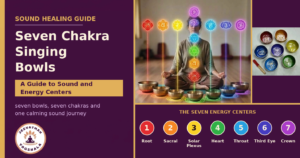
| Muladhara (root) | LAM | 396 Hz | Base of spine |
| Svadhisthana (sacral) | VAM | 417 Hz | Lower abdomen |
| Manipura (solar plexus) | RAM | 528 Hz | Above the navel |
| Anahata (heart) | YAM | 639 Hz | Centre of chest |
| Vishuddha (throat) | HAM | 741 Hz | Throat |
| Ajna (third eye) | OM / KSHAM | 852 Hz | Between the eyebrows |
| Sahasrara (crown) | Silence / OM | 963 Hz | Top of the head |
To practise: chant each syllable on a comfortable low pitch, one long exhale per repetition, seven repetitions per chakra, working upward. The felt vibration in the corresponding body region is the point — not hitting a target frequency. Related reading: kundalini awakening and yoga, aura colours and their meaning, and the Surya Namaskar mantras for a worked example of mantra practice with sequence.
What the science says about solfeggio frequencies and healing claims
The 528 Hz “DNA repair” claim
This is the most repeated and least supported claim in the field. It originates with Puleo and Horowitz’s writing, not with any laboratory study. A small in-vitro experiment published in 2018 reported reduced ethanol-induced cell damage under 528 Hz exposure — a single, unreplicated study on cells in a dish, with no bearing on what happens when a human being listens to a tone through headphones. Treat “528 Hz repairs your DNA” as false.
Binaural beats
Binaural beats — two slightly different frequencies presented to each ear, producing a perceived third pulse — are a genuine auditory phenomenon and have been studied far more seriously than the solfeggio frequencies. The evidence is mixed: some trials report modest reductions in pre-procedural anxiety, others find no effect beyond ordinary relaxing music. Headphones are required; through speakers the effect does not occur.
What is actually well-supported
The robust finding across the music-and-relaxation literature — summarised without hype by the US National Center for Complementary and Integrative Health — is that slow tempo, predictable structure, low volume and adequate duration reliably reduce physiological arousal. Pitch is far down the list. A 20-minute recording at 60 beats per minute will out-perform a 3-minute clip labelled 528 Hz, every time. It is telling that the most cited study in this whole field, Goldsby and colleagues, 2017, measured live singing bowl meditation rather than any specific frequency — and that Cleveland Clinic’s write-up of sound baths does not mention solfeggio tones at all. The frequency label is doing much less work than the listening conditions.
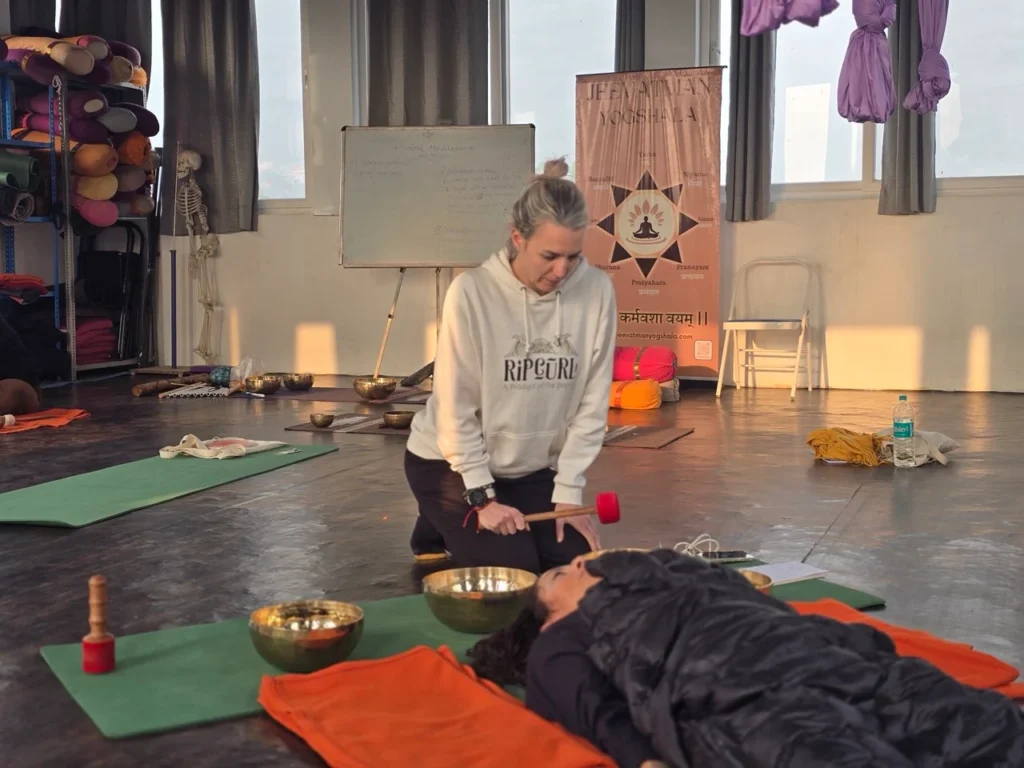
This is the same conclusion we reach in our wider guide to how sound healing works — and it is why live instruments, played by someone reading the room, outperform any recording. A struck Tibetan singing bowl produces dozens of shifting overtones at once, which is far more absorbing to the ear than a single synthesised sine wave.
How to use solfeggio frequencies practically
If you want to experiment with solfeggio frequencies, do it properly: same time each day, headphones or a decent speaker, moderate volume, eyes closed, at least 15 minutes. Treat the solfeggio frequency as the container for attention rather than as the active ingredient.
| If you want | Commonly used | What matters more |
|---|---|---|
| Easier sleep onset | 174 Hz, 396 Hz, delta binaural | Low volume, no fade-outs, 30+ min, consistent bedtime |
| Anxiety in the moment | 396 Hz, 432 Hz music | Extending the exhale longer than the inhale |
| Focus while working | 40 Hz gamma binaural | No lyrics, low volume, unchanging texture |
| Deep meditation | Live bowls, OM chant, 963 Hz | Duration and stillness. Live sound over recordings |
| Emotional release | Gong, low bowls, 639 Hz | A facilitated setting where release is safe — see our sound bath guide |
Safety notes
Keep volume below roughly 60% on headphones; solfeggio frequencies tracks are often played loud for long stretches, which is a real hearing risk. If you have epilepsy, avoid pulsing and isochronic tones. If you have tinnitus or hyperacusis, sustained pure tones can worsen symptoms — stop if they do. And no frequency should ever replace prescribed treatment for a diagnosed condition.
Red flags when someone sells you solfeggio frequencies
- Claims a specific Hz value cures a named disease.
- Cites “DNA repair”, “cellular detoxification” or “raising your vibration to 5D” as mechanisms.
- Says the frequencies were suppressed by the Church, governments or the music industry.
- Sells expensive proprietary hardware to generate tones any free app produces identically.
- Discourages you from continuing medical treatment.

The yogic view: nada, not numbers
Classical Nada Yoga takes a different route to the same territory. It distinguishes ahata nada — struck sound, anything with a measurable frequency — from anahata nada, the unstruck inner sound perceived when attention becomes still enough. In that framework, the solfeggio frequencies and every other external tone are a training aid whose whole purpose is to be outgrown. Fixating on which number is correct is, from that view, a category error: the practice is listening, not tuning.
This is the framing we work from at our school in Rishikesh, where sound sits inside a full yogic context rather than being taught as a standalone wellness product. Our sound healing course in Rishikesh covers solfeggio frequencies and frequency theory honestly — including which claims not to make to clients — alongside instrument technique and supervised session facilitation. See also awakening the OM within and, for the nervous-system side, yoga for mental health.
How to generate solfeggio frequencies yourself
You do not need to buy a course, an app subscription or a special speaker. A solfeggio frequency is a sine wave at a stated number of cycles per second, and every method below produces an acoustically identical result.
- A free tone generator. Any browser-based or open-source tone generator outputs an exact frequency. Type 528, press play. That is the entire product some sites charge a subscription for.
- A tuner app, used in reverse. Pitch-detection apps tell you what frequency your bowl, voice or instrument is actually producing — far more useful than trusting a seller’s chakra label.
- Tuning forks. Weighted forks are manufactured to a specific pitch and are the only common physical instrument tuned precisely enough to claim a frequency honestly.
- Your own voice. A sustained hum sits roughly between 85 and 255 Hz for most adults. You will not reach 528 Hz, and it does not matter — the felt vibration in the chest and skull is doing the work.
One practical warning that almost nobody mentions: a phone speaker cannot reproduce anything below about 300 Hz at usable volume. If you are playing 174 Hz or 285 Hz through a handset, you are hearing harmonics and speaker distortion, not the stated tone. Use headphones or a speaker with a real driver, or the exercise is pointless.
Why chakra frequency charts disagree with each other
Search for a chakra frequency chart and you will find at least three incompatible systems. The root chakra is given as 396 Hz on one page, 194.18 Hz on another and 256 Hz on a third. None is wrong within its own logic, because each is derived from a completely different starting point.
- The solfeggio mapping (396–963 Hz) lays Puleo’s nine tones over the seven chakras from the bottom upward. It is the newest and now the most widely repeated.
- The cosmic octave figures — commonly 194.18 Hz for the root and 172.06 Hz for the crown — come from Hans Cousto’s work transposing planetary and orbital periods up into audible range. Internally consistent, and entirely dependent on the second being your unit of time.
- The C-major mapping (256, 288, 320, 341.3, 384, 426.7, 480 Hz) assigns a diatonic scale to the chakras. This is why crystal bowls are sold labelled C through B rather than in hertz.
The useful takeaway is not which chart to trust. It is that a set of tones invented in the 1970s, a system derived from planetary astronomy, and a mapping borrowed from Western musical notation all claim the same authority over the same seven points in the body. Treat the number as a label for organising your practice — not as a measurement of anything anatomical.
Frequently asked questions about solfeggio frequencies
Are solfeggio frequencies scientifically proven?
No. There is no peer-reviewed evidence that any specific solfeggio frequency produces the effect attributed to it. What is supported is that slow, quiet, predictable sound reduces physiological arousal — an effect driven by tempo, volume and duration rather than by pitch. Listening is harmless and may help you relax; the specific number is not the reason.
What does 528 Hz actually do to the body?
Acoustically, it is a C-sharp-ish tone. It does not repair DNA, and no human study supports that claim. Listening to a sustained 528 Hz tone will slow your breathing and settle your attention in the same way any sustained tone does. The “miracle tone” framing comes from 1990s numerology writing, not from research.
Which solfeggio frequency is best for sleep?
174 Hz and 396 Hz are the most commonly recommended, and delta-range binaural beats are also popular. In practice, what determines whether a track helps you sleep is that it is quiet, long enough to outlast your sleep onset, free of volume changes, and used at a consistent time — not which of those frequencies you pick.
Is 432 Hz really better than 440 Hz?
There is no established physiological advantage. One small crossover study found slightly lower heart rate with 432 Hz music, which has not been replicated at scale. Many listeners describe 432 Hz as warmer, and that subjective preference is a legitimate reason to choose it. The historical claim that 440 Hz was imposed as propaganda is false.
How long should you listen to healing frequencies?
Fifteen to thirty minutes is the usual effective range for a relaxation session. Below ten minutes the nervous system rarely has time to shift. Beyond about an hour of continuous headphone listening, hearing-safety considerations start to outweigh any additional benefit — keep the volume moderate throughout.
Can I listen to solfeggio frequencies while sleeping?
You can, at low volume through a speaker rather than headphones or earbuds — sleeping with in-ear devices risks ear canal irritation and, at sustained volume, hearing damage. Use a track with no volume changes, and set a timer rather than looping all night.
What are the 7 chakra frequencies?
The most widely circulated set is 396 Hz (root), 417 Hz (sacral), 528 Hz (solar plexus), 639 Hz (heart), 741 Hz (throat), 852 Hz (third eye) and 963 Hz (crown). These assignments are modern and vary between sources. The traditional practice is the bija mantras — LAM, VAM, RAM, YAM, HAM, OM — which are far older and require no equipment.
Do solfeggio frequencies work through speakers or do I need headphones?
Solfeggio frequencies work through either. Binaural beats specifically require stereo headphones, because the effect depends on each ear receiving a different frequency. If a product claims binaural benefits through a single speaker, it does not work as described.
Can healing frequencies be harmful?
Rarely, with three real exceptions: sustained loud listening is a hearing risk; pulsing and isochronic tones can be a trigger for people with photosensitive or audiogenic epilepsy; and sustained pure tones can aggravate tinnitus and hyperacusis. The larger harm is indirect — delaying real treatment because a frequency was presented as a cure.
Where can I learn to work with sound properly rather than just listening to tracks?
Look for training that teaches instrument technique, session structure, contraindication screening and the honest limits of what you can claim to a client. Our sound healing course in Rishikesh covers all four, and the wider career path is set out in how to become a sound healer.