A sound bath is a group meditation in which you lie down, fully clothed, and listen while a facilitator plays singing bowls, gongs and chimes for 45 to 60 minutes. You do nothing. There is no technique to learn, no posture to hold, and no way to get it wrong. Most first-timers spend ten minutes wondering whether they are doing it right, then lose track of time entirely.
Key takeaways
- Duration: 45–75 minutes. Arrive 15 minutes early; the settling-in matters more than people expect.
- What to wear: loose, warm layers. Body temperature drops when you stop moving — bring socks and a blanket.
- Falling asleep is fine. So is crying. Both are common and neither means the session failed.
- Not for everyone: avoid or seek advice first if you have epilepsy, severe tinnitus, a pacemaker, or are in acute psychiatric crisis.
- At home: one bowl, 30 minutes and a timer will get you most of the way. A recording will not.
What is a sound bath?
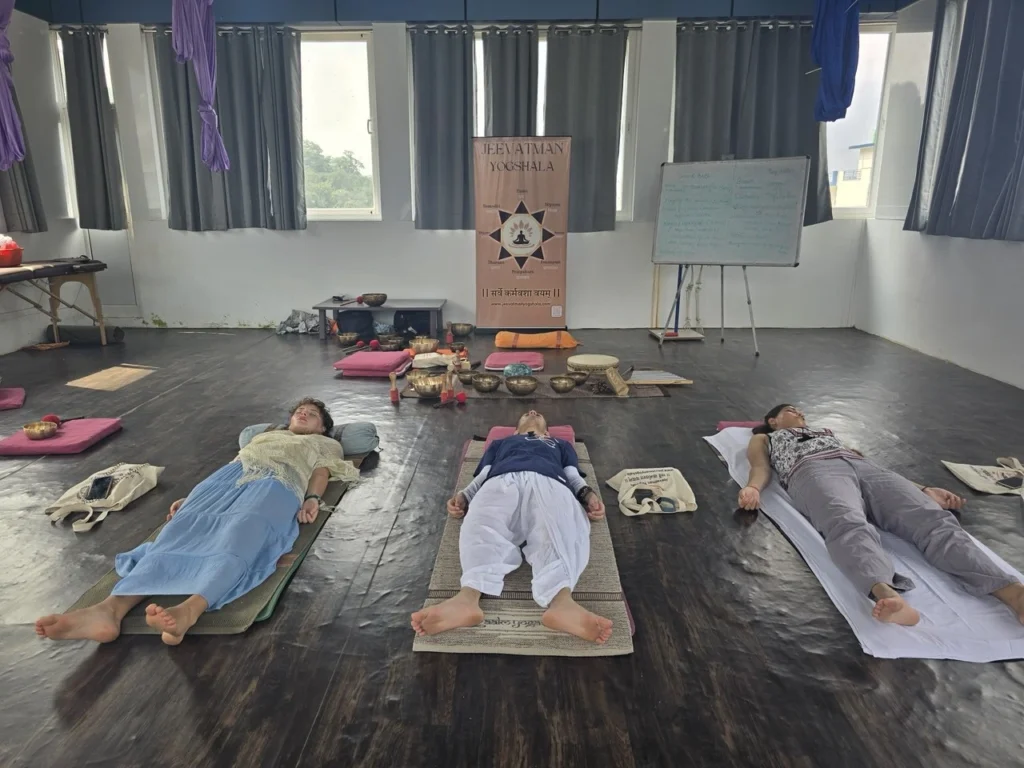
A sound bath is a specific format within the wider practice of sound healing: participants lie on mats in a darkened room while continuous, overlapping instrument tones fill the space. The name is metaphorical — nothing gets wet. You are “bathed” in sound in the sense of being surrounded by it from all directions.
Sound bath meditation grew out of gong meditation in Kundalini yoga and Himalayan bowl practice, and it spread quickly for a practical reason: it is the easiest deep-relaxation practice for a beginner to access. Seated meditation asks you to generate and sustain attention yourself. A sound bath supplies the object of attention for you. People who have failed at meditation for years frequently reach a genuinely altered state on their first attempt here, which is both its great strength and the reason it is sometimes oversold.
Sound bath vs sound healing vs gong bath
| Format | Instruments | Intensity | Good first choice? |
|---|---|---|---|
| Sound bath | Mixed — bowls, chimes, some gong | Moderate, gradual arc | Yes |
| Gong bath | Gong-dominant, often very loud | High — overwhelming for some | No — go second or third |
| Singing bowl session | Metal bowls only, sometimes on-body | Low, tactile | Yes — gentlest option |
| Crystal bowl session | Quartz bowls, pure loud tones | High volume, piercing | Not if sound-sensitive |
| Nada Yoga / OM practice | Voice and chant — you participate | Active rather than receptive | Yes, if you prefer doing to receiving |
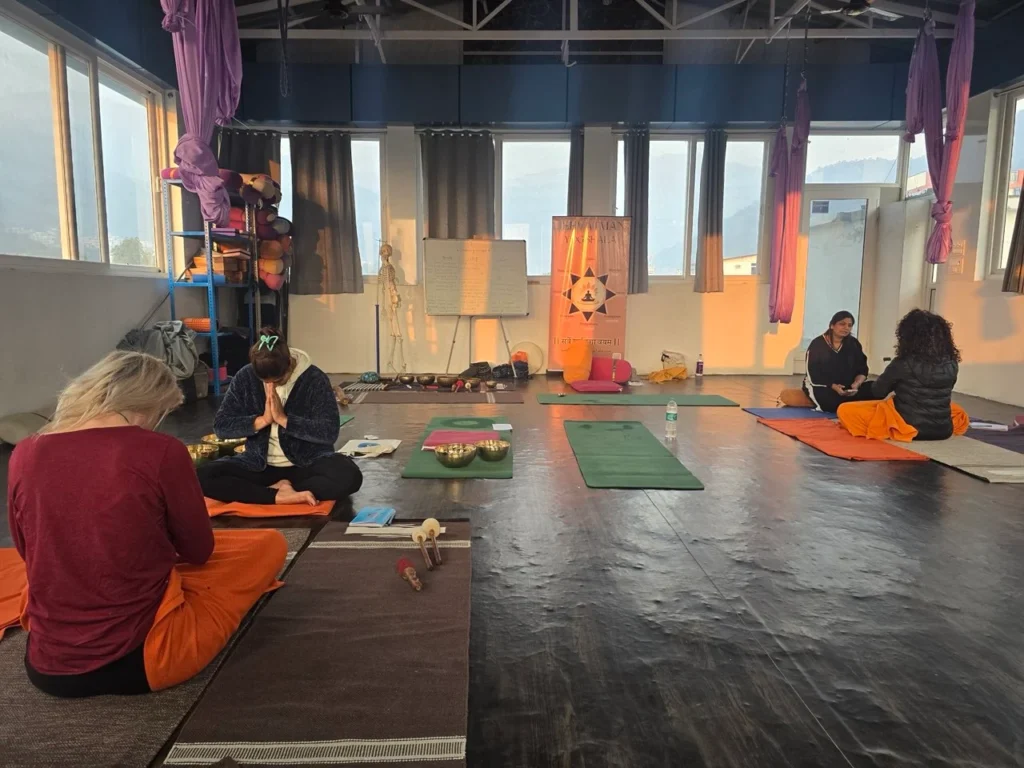
What to expect at your first sound bath: minute by minute
Before you go in. You will be asked to remove shoes and phones, and a good facilitator will ask about health conditions — hearing sensitivity, epilepsy, pregnancy, implants, recent surgery. If nobody asks, that is a signal about the quality of the training, not a sign of a relaxed atmosphere.
0–10 minutes: settling. Lying on your back with a bolster under the knees and a blanket over you. The facilitator usually opens with a few words and a breath instruction, then a single low bowl. This stretch is often uncomfortable — the body has stopped moving but the mind has not. Fidgeting is normal. Do not fight it.
10–20 minutes: the drop. The jaw releases, shoulders sink, breathing lengthens without effort. Many people experience an involuntary twitch or a deep unbidden sigh here — that is a normal marker of the nervous system shifting out of guard mode.
20–45 minutes: the deep section. This is where gongs and layered bowls usually arrive. Time perception distorts badly; a twenty-minute stretch can feel like five or like an hour. Vivid imagery, colours behind closed eyes, and short micro-sleeps are all common. Some people hear the sound as though it is coming from inside their head rather than the room.
45–60 minutes: the return. Volume drops, high chimes replace low tones, and the facilitator brings you back deliberately — small movements, deeper breath, sitting up slowly. Standing too fast here genuinely makes people dizzy.
Afterwards. Expect an hour or two of feeling spacious, slightly slowed down and quite thirsty. Do not schedule anything demanding immediately after. Many people report unusually deep sleep that night.
What to wear and bring to a sound bath
- Loose, non-restrictive clothing. Nothing with a waistband that digs in when you lie flat for an hour.
- Warm layers and socks. Core temperature drops noticeably during deep relaxation. Being cold is the single most common reason people cannot settle.
- Your own blanket if the venue does not provide one, plus a small cushion for under the head.
- An eye pillow or scarf — blocking residual light helps considerably.
- Water. Drink before and after, not during.
- Leave behind: phone (fully off, not silent), strong perfume, a full stomach. Eat lightly two hours before.
Sound bath benefits — what is actually supported
The realistic claim is short-term: sound bath benefits centre on reduced tension, improved mood and easier access to deep rest, lasting hours to a couple of days. The most cited evidence is a 2017 observational study by Goldsby and colleagues in the Journal of Evidence-Based Complementary & Alternative Medicine, which found significant reductions in reported tension, anger, fatigue and depressed mood across 62 participants — with the largest effects among people attending for the first time. A 2025 systematic review in Integrative Medicine Research found the same pattern across the singing bowl literature and flagged the same weakness: small samples, no control groups.
So a sound bath is a good, low-risk way to reach a deeply rested state. It is not a treatment for a diagnosed condition, and anyone marketing it as one is overreaching. Cleveland Clinic’s overview of sound baths says the same thing in plainer language, and the US National Center for Complementary and Integrative Health reaches that verdict across relaxation techniques generally. The full evidence picture, including the claims that do not hold up, is in our guide to how sound healing works, and the frequency-specific claims are examined in solfeggio frequencies explained.
Why do people cry during sound baths?
It is common enough that experienced facilitators plan for it. Three things are happening at once: sustained relaxation lowers the effort your nervous system spends holding emotional material down; long low tones — especially gongs — are physically felt in the chest and abdomen, where held tension tends to sit; and lying still with nothing to do removes every distraction you normally use.
If it happens to you, it is not a crisis and it does not require explanation to anyone. A good facilitator will notice, stay nearby, and not make it a spectacle. If it happens repeatedly and leaves you distressed rather than lighter afterwards, that is worth raising with a therapist — sound work can surface material, but it is not equipped to process it.
Who should not do a sound bath
Speak to your doctor first, and tell the facilitator before the session, if any of these apply:
- Epilepsy or seizure history — loud, rhythmically pulsing gong sections are a recognised risk. Many facilitators will offer a quieter position in the room or advise against gong-heavy sessions.
- Severe tinnitus, hyperacusis or Ménière’s disease — sustained loud overtones can flare symptoms for days.
- Pacemaker or implanted device — attend, but no on-body bowl placement.
- Pregnancy — generally fine at moderate volume, but avoid gong-heavy sessions and on-body bowls, and lie on your side after the first trimester.
- Acute psychosis, mania, or active dissociation — deep altered states can destabilise. Not a substitute for psychiatric care.
- Recent concussion or migraine in progress — wait.
- Very young children — shorten to 15–25 minutes and skip gongs entirely.
How to do a sound bath at home
You cannot fully replicate a group session alone, but you can get a surprising amount of the benefit with one bowl and thirty minutes. Live sound beats recordings by a wide margin — audio compression strips out the overtone complexity that makes the sound absorbing in the first place.
What you need
One hand-hammered metal singing bowl (15–20 cm is ideal), a suede-tipped mallet, a mat, a blanket, an eye covering and a silent timer. Our guide to Tibetan singing bowls covers choosing and playing one properly, including why most beginners’ bowls refuse to sing.
A 30-minute home sound bath template
| Time | What to do |
|---|---|
| 0–5 min | Sit upright. Bowl in your lap. Ten slow breaths with the exhale twice as long as the inhale. |
| 5–15 min | Strike once. Listen until the tone is completely gone — 40–90 seconds. Strike again. Repeat. Do not rush the silence; the silence is the practice. |
| 15–20 min | Chant a long, low OM on each exhale, seven times. Feel the vibration in the chest, throat and face. |
| 20–28 min | Lie down, covered and warm. No sound at all. This silent stretch is where the shift consolidates. |
| 28–30 min | One final soft strike. Move your fingers and toes. Sit up slowly. |
Done three or four times a week, this outperforms a monthly group session for almost everyone. Consistency beats intensity — which is unromantic and true of every contemplative practice.
How to choose a good facilitator
Sound healing is unregulated everywhere in the world. Anyone can print a certificate and run a session tomorrow. That puts the assessment burden on you, so here is what actually distinguishes competent practice:
- They screen you for epilepsy, hearing conditions, pregnancy and implants before you lie down.
- They manage volume. A session that leaves your ears ringing was played too loud, full stop.
- They build an arc — a gradual rise and a deliberate return — rather than playing continuously at one intensity.
- They stay present at the end rather than disappearing the moment the last chime fades.
- They do not make medical claims. “This will cure your condition”, “this repairs your DNA” or “this detoxifies your cells” are reasons to leave.
How often should you attend?
Once a week to once a fortnight is a sensible rhythm for group sound bath meditation, supported by short daily home practice. The effect of a single session fades within a day or two; the durable changes people report — lower baseline reactivity, better sleep — come from repetition over weeks. Attending monthly and expecting cumulative benefit is the most common way people conclude sound work “doesn’t do much”.
Learning to facilitate sound baths
If you have attended a few and want to run them yourself, the skills that matter in sound bath meditation are unglamorous: instrument technique to a reliable standard, session architecture (knowing why the gong enters at minute 28 and not minute 8), volume discipline, contraindication screening, and holding a room when someone has an emotional release.
Our sound healing course in Rishikesh is built around exactly that sequence, with supervised facilitation of real sessions rather than observation only. For teachers folding sound into asana classes, our 200-hour yoga teacher training and 50-hour aerial yoga TTC with sound healing both integrate it into the closing sequence. The broader professional route — pricing, insurance, building a client base — is set out in how to become a sound healer, and what students take away from the training itself is described in the benefits of a sound healing TTC.
If you would rather experience it before committing to training, sound sessions run daily as part of our yoga retreat in Rishikesh and the 7-day spiritual retreat.
Sound bath vs yoga nidra: which should you choose?
These two get recommended interchangeably and they do different jobs. Both have you lying down for 30 to 60 minutes, both target the same rest state, and the choice between them comes down to whether you want instruction or silence.
Yoga nidra is verbally guided from start to finish. A teacher walks you through a systematic rotation of awareness around the body, and you are given something specific to do every thirty seconds. That structure is why nidra works well for people whose minds race — there is no idle time for rumination to fill. It also carries a sankalpa, a short intention repeated at the beginning and end, which a sound bath has no equivalent of.
A sound bath gives you no instructions at all after the first minute. The instrument holds your attention instead of a voice. That suits people who find guided meditation intrusive, and it suits anyone who wants an emotional release rather than a structured practice — the wordlessness is precisely what lets held material surface.
In practice: choose yoga nidra if your problem is a busy mind and you want a repeatable protocol. Choose a sound bath if your problem is a body that will not switch off, or if guided voices irritate you. Many people alternate them week to week, and our Rishikesh yoga retreat schedules both for exactly that reason.
What to do if you cannot settle in a sound bath
Roughly one person in five leaves a first session frustrated rather than rested. That is normal and almost always fixable. The usual causes, in order of how often they turn out to be the problem:
- You are cold. By far the most common. Your core temperature drops within fifteen minutes of lying still. Socks and a second blanket solve more failed sessions than any technique.
- Your lower back hurts. Lying flat flattens the lumbar curve. Put a bolster or rolled blanket under the knees — this single change fixes most physical restlessness.
- You are trying to do it right. There is no correct experience. Wandering thoughts, boredom and clock-watching are not failures; noticing them and returning to the sound is the practice.
- The volume is wrong for you. If the gong feels like an assault rather than a wave, move further from the instruments. Ask beforehand — a good facilitator will place you.
- You are too full, or too caffeinated. Eat lightly two hours before and skip coffee after midday if you are attending an evening session.
If three sessions in a row leave you agitated rather than settled, sound work may simply not suit your nervous system, and that is a legitimate finding rather than a personal failure. Try a gentler bowl-only session before concluding anything.
Frequently asked questions about sound baths
What actually happens at a sound bath?
You lie down on a mat, fully clothed and covered, in a dim room. A facilitator plays singing bowls, gongs and chimes continuously for 45 to 60 minutes while you rest with your eyes closed. There is no participation required. Most people drift between waking and sleep for much of it and lose track of time entirely.
What should I wear to a sound bath?
Loose clothing with no tight waistband, plus warm layers and socks. Your body cools noticeably once you stop moving, and being cold is the most common reason people fail to settle. Bring a blanket if the venue does not supply one, and something to cover your eyes.
Is it OK to fall asleep during a sound bath?
Yes, and it is very common — particularly at a first session and for anyone sleep-deprived. You still get the nervous-system benefit, and even in light sleep some auditory processing continues. If snoring worries you, lie on your side rather than your back.
How long does a sound bath last?
Typically 45 to 75 minutes of playing, plus 10–15 minutes of arrival and settling. Under 30 minutes rarely gives the nervous system time to shift properly. Beyond 90 minutes most people surface groggy rather than more rested.
Can a sound bath be too intense?
Yes. Gong-heavy and crystal bowl sessions can be genuinely overwhelming, especially for sound-sensitive people, and volume discipline varies enormously between facilitators. If you find it too much, move further from the instruments or leave — a competent facilitator will not take offence. Start with a bowl-based session rather than a gong bath.
Is a sound bath the same as meditation?
Not quite. Meditation trains you to generate and hold attention yourself; sound bath meditation supplies the attention anchor for you. That makes it much easier to reach a deep state, but the skill is less transferable. The two work best together — sound to learn what a settled state feels like, seated practice to learn to find it unaided.
Can I do a sound bath while pregnant?
Usually yes at moderate volume, with three caveats: avoid gong-dominant sessions, do not allow bowls to be placed on your body, and lie on your left side rather than flat on your back after the first trimester. Tell the facilitator you are pregnant before the session starts, and check with your midwife or doctor.
Do I need to bring anything to a sound bath?
Most studios provide mats, bolsters and blankets, but bringing your own blanket, socks, eye covering and a water bottle removes any uncertainty. Arrive 15 minutes early — walking in flustered costs you the first ten minutes of the session.
Are online or recorded sound baths worth it?
They are better than nothing and useful for building a daily habit, but noticeably weaker. Audio compression flattens the overtone complexity and the physical, felt component of low frequencies does not transmit through headphones or small speakers at safe volume. Use recordings between live sessions, not instead of them.
How much does a sound bath cost?
Group sessions typically run $20–$45 in Western cities and ₹500–₹1,500 in Rishikesh, with one-to-one sessions considerably more. Many yoga retreats and teacher trainings include daily sessions in the programme fee — ours run as part of the Rishikesh yoga retreat and the sound healing course.