A Tibetan singing bowl is a hand-hammered bronze bowl that produces a long, overtone-rich tone when struck or rimmed with a mallet. You play it by resting it flat on an open palm, striking the outer wall once, and letting the note decay completely — or by circling the mallet firmly around the outer rim to build a continuous hum. Most beginners fail at the second technique for one reason: too fast, too little pressure.
Key takeaways
- Best first bowl: a hand-hammered bronze bowl, 15–20 cm across, with a suede-wrapped mallet. Roughly ₹2,500–₹9,000 in Rishikesh, $40–$150 abroad.
- The “seven sacred metals” story is largely marketing. Metallurgical analysis of antique bowls shows ordinary bronze — copper and tin with trace impurities.
- Why bowls won’t sing: curled fingers, wrong mallet, too much speed, too little pressure, or a decorative bowl that was never made to resonate.
- Tibetan vs crystal: metal bowls are forgiving and complex; crystal bowls are loud, pure and much easier to overuse.
- Never place a bowl on the body over a pacemaker, implant, recent surgery site, or a pregnant abdomen.
What is a Tibetan singing bowl?
Tibetan singing bowls — more accurately called Himalayan singing bowls, since most are made in Nepal and northern India rather than Tibet — are standing bells made of bronze. Instead of hanging and being struck from outside, they sit rim-up and are played from above. The bowl’s walls flex in complex vibrational modes, producing a fundamental note plus a stack of inharmonic overtones that beat against each other. That beating is what creates the shimmering, alive quality no synthesiser reproduces convincingly.
They arrived in Western wellness culture in the 1970s, and the “ancient Tibetan sound healing tradition” framing arrived with them. The honest history is murkier: bowls of this kind were widely used as household vessels across the Himalayas, and their systematic use as therapeutic instruments is largely a modern development. That does not make the practice less useful. It makes the marketing less trustworthy — a distinction worth holding on to. For the wider context of how these instruments fit into a session, see our guide to what sound healing is and how it works.
What are singing bowls actually made of?
You will be told, often insistently, that a real bowl contains seven metals corresponding to seven planets, including meteoric iron. Published metallurgical analyses of antique Himalayan bowls consistently find something more ordinary: bronze — copper and tin, typically in the region of 3:1 to 4:1, with trace amounts of zinc, iron and lead as impurities of the smelting process rather than deliberate additions.
This matters practically, not just intellectually. A shop that charges a premium for the seven-metals story is charging for a story. What you should actually pay for is hand-hammering — the visible, irregular dimples across the surface that create the asymmetry responsible for a rich overtone spread. Machine-spun bowls are smooth, cheap, and sound thin and one-dimensional by comparison.
Types of Tibetan singing bowls
| Type | Sound character | Best for | Typical price |
|---|---|---|---|
| Hand-hammered bronze | Warm, many overtones, long decay | Everything. The default choice | $40–$300 |
| Machine-made / cast | Thin, short decay, single obvious pitch | Decoration. Avoid for practice | $10–$35 |
| Antique (pre-1950) | Distinctive, often uneven, prized | Experienced players. Heavily faked | $300–$3,000+ |
| Frosted crystal quartz | Pure, very loud, one dominant tone | Large group sound baths | $80–$400 |
| Clear / alchemy crystal | Bright, glassy, penetrating | Specialist use. Fragile and costly | $250–$1,500 |
| Full-moon / Jambati style | Very low fundamental, deep body-felt | Grounding and closing a session | $150–$600 |
Tibetan vs crystal singing bowls: which should you buy?
Buy metal first. Tibetan singing bowls are far more forgiving of technique, portable, effectively unbreakable, and their overtone complexity is what makes a solo practice interesting over years rather than weeks. Crystal singing bowls produce a purer and much louder tone that fills a large room — genuinely useful for a group of thirty — but that same purity gets monotonous in a small space, and the volume is a real risk for anyone with hearing sensitivity.
The common progression among practitioners is three to five metal bowls first, one crystal bowl added later for contrast, and a gong last.
How to play a Tibetan singing bowl
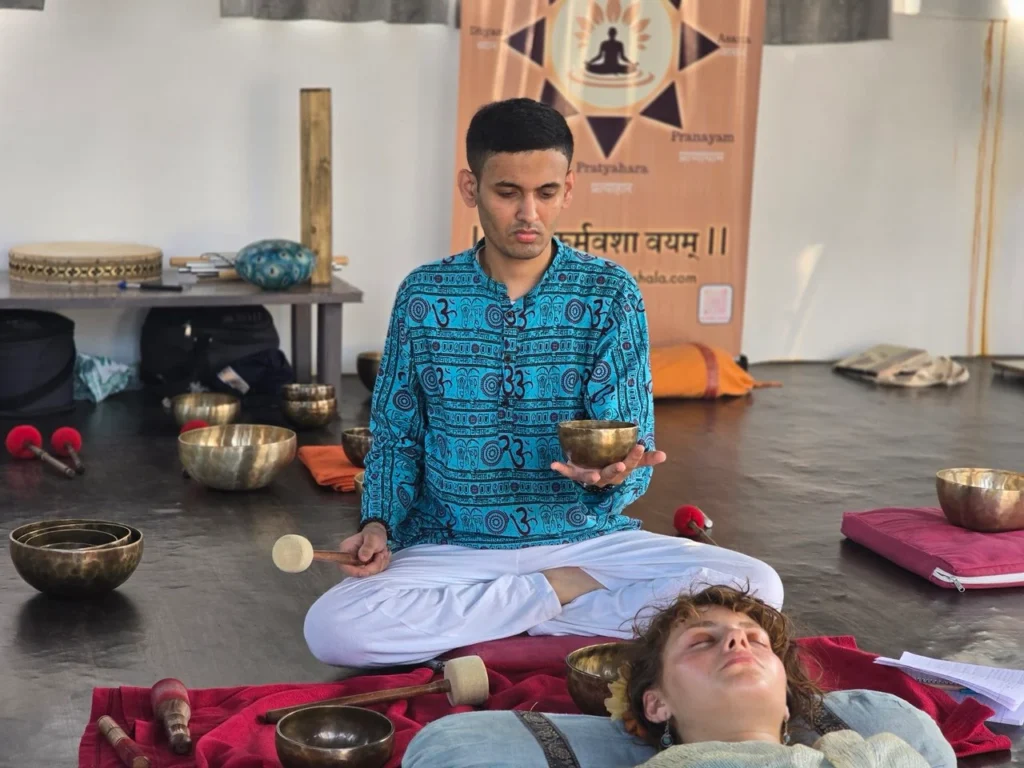
There are two techniques and most people learn them in the wrong order. Learn striking properly first — it is where the listening happens. Rimming is the technique everyone wants to learn and the one that produces the worst results when rushed.
Step 1: How to hold the bowl
Rest the bowl flat on your open, extended palm — fingers straight and pressed together, thumb out to the side. Do not curl your fingers up around the bowl. Curled fingers touch the vibrating wall and kill the tone within a second or two; this single mistake accounts for most “my bowl sounds dead” complaints. For bowls over about 20 cm, use a flat cushion or a felt ring instead of your hand.
Step 2: Striking
Hold the mallet loosely and strike the outer wall about two to three centimetres below the rim — not the rim edge itself, which produces a clanking attack. One strike. Then do nothing. Let the note run its full decay, which on a good medium bowl is 40 to 90 seconds. The discipline of waiting for complete silence before striking again is the actual practice; everything else is decoration.
Step 3: Rimming (making it “sing”)
This is where beginners struggle, so here are the parameters precisely:
- Mallet: use the suede or leather-wrapped end, not bare wood. Bare wood chatters.
- Grip: hold the mallet upright, like holding a small hammer, thumb along the top.
- Contact: press against the outside of the rim at roughly 45 degrees, with the full length of the mallet head in contact — not the tip.
- Pressure: firm and constant. Most people use about half the pressure required.
- Speed: slow. Around one full revolution every 2–3 seconds. Speeding up does not increase volume; it breaks the sustain.
- Starting the tone: strike once first, then begin circling. Building from silence is harder.
When the bowl locks in, you will feel the mallet grip the wall and the tone will rise on its own. At that point reduce pressure slightly and hold it steady.
Step 4: The water technique
Fill the bowl one-third to one-half with water and rim it slowly. The vibrating wall drives standing wave patterns across the surface, and as amplitude increases, droplets jump upward. It is visually striking and genuinely useful for teaching children and sceptics what “vibration” means, because they can see it. Use a bowl you do not mind wetting, and dry it fully afterwards.
Step 5: On-body bowl placement
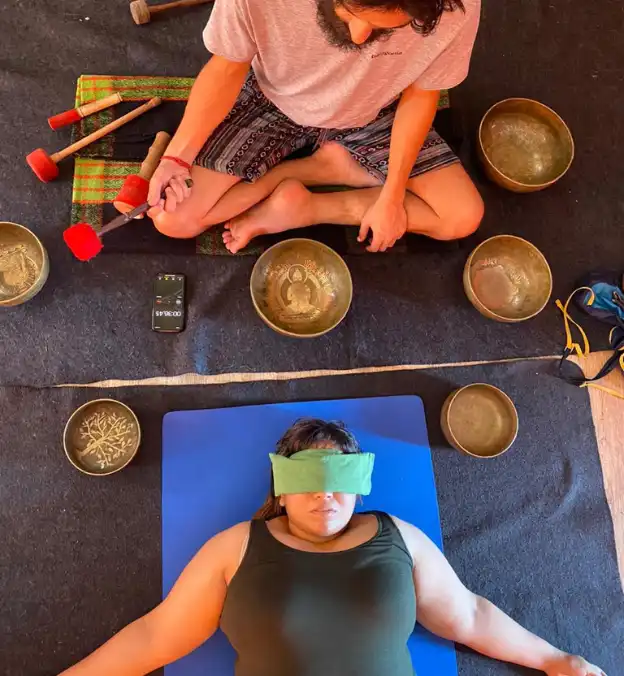
Placing a bowl directly on a reclining person’s body and striking it gently transmits vibration through tissue — the technique often marketed as vibroacoustic or vibrational sound therapy. Done carefully it is one of the most physically compelling experiences in this modality. Done carelessly it is how people get hurt.
Rules: place the bowl only on flat, well-supported areas (sternum, abdomen, sacrum, thighs, upper back). Strike softly — a fraction of your normal force. Never place a bowl over the head, throat, spine, a pacemaker or implant, a recent surgical site, a fracture, or a pregnant abdomen. Ask before you touch. Screening for these is part of any serious training, including our sound healing course in Rishikesh.
Why your singing bowl won’t sing — six causes and fixes
| Symptom | Cause | Fix |
|---|---|---|
| Tone dies in 2 seconds | Fingers curled around the bowl wall | Flatten the palm completely, fingers straight |
| Rattling / chattering while rimming | Mallet too hard, or speed too high | Switch to suede end; halve your speed; increase pressure |
| No hum builds at all | Not enough pressure against the rim | Press noticeably harder — the mallet should feel like it is dragging |
| Thin, tinny, short note | Machine-made decorative bowl | Look for hammer marks; if the surface is perfectly smooth, replace it |
| Buzzing at high volume | Hairline crack, or debris inside | Empty and inspect. A cracked bowl cannot be repaired |
| Works on cushion, not on hand | Bowl too heavy for hand support | Normal above ~20 cm. Use a ring cushion |
How to choose your first singing bowl
Size determines pitch. Larger bowls have lower fundamentals and longer decay; smaller bowls are higher, brighter and cut through a room.
| Diameter | Pitch range | Use |
|---|---|---|
| 10–14 cm | High, bright | Travel, opening and closing bells, on-body at the feet |
| 15–20 cm | Mid | Best all-round first bowl. Hand-playable, versatile |
| 21–27 cm | Low-mid | Group work, on-body placement, needs a cushion |
| 28 cm+ | Very low, felt in the chest | Grounding and closing. Heavy and expensive |
Buying advice that actually matters: play the bowl before you buy it, and if you are buying online, only buy where an audio sample of that specific bowl is provided — no two hand-hammered bowls sound alike. Look for visible hammer dimples. Check for hairline cracks by striking hard once and listening for buzz. Ignore chakra and note labelling entirely; it is assigned loosely by sellers and is not a reliable measurement.
Benefits of Tibetan singing bowls, assessed honestly
The evidence base is thin but not absent. The most cited study — Goldsby and colleagues, 2017, in the Journal of Evidence-Based Complementary & Alternative Medicine — followed 62 adults through singing bowl sound meditation and found significant reductions in reported tension, anger, fatigue and depressed mood, with the largest effects among people new to the practice. A 2025 systematic review in Integrative Medicine Research assessed the clinical singing bowl literature as showing consistent short-term wellbeing improvements while criticising small samples and absent control groups.
So: singing bowl benefits that are reasonably supported are short-term stress reduction, mood improvement and easier relaxation. Claims about cellular detoxification, DNA repair, or curing disease have no supporting evidence and should be treated as a reason to walk away from a seller or teacher. For a neutral baseline on how this class of practice is assessed, the US National Center for Complementary and Integrative Health summarises the relaxation-technique evidence without the marketing, and Cleveland Clinic does the same for sound baths. We cover the full evidence picture in our sound healing pillar guide, and the frequency claims specifically in solfeggio frequencies explained.
How to care for a singing bowl
- Do not polish antique or hand-hammered bowls. The patina is part of the value and aggressive polishing can alter the tone.
- Wipe with a dry or barely damp cloth. Avoid metal polish, vinegar and abrasives.
- Store rim-up on a cushion, never stacked inside another bowl — that is how rims chip.
- Dry completely after any water technique. Standing water leaves mineral rings.
- Travel with the bowl wrapped in cloth and the mallet stored separately.
Building a set for facilitating sessions
If you intend to run sessions rather than practise alone, a workable starter set is: one small bowl (12 cm) for opening and closing, two mid bowls (17 cm and 20 cm) tuned a whole tone or so apart so they beat against each other, one large bowl (26 cm+) for grounding, a pair of tingsha cymbals, and a koshi chime for the return. That covers a full 45-minute arc without repetition.
Two bowls close but not identical in pitch is the single most valuable purchase decision — the slow beating between them is the effect people describe as “the sound moving around the room”. Learning to sequence these instruments deliberately is what separates a session from an hour of pleasant noise, and it is the core of what we teach on our sound healing training in Rishikesh. The full professional path — pricing, insurance, client work — is covered in how to become a sound healer.
Teachers integrating bowls into asana classes usually add them to the closing sequence; if that is your interest, our 200-hour yoga teacher training in Rishikesh and 50-hour aerial yoga TTC with sound healing both build that in. For how bowls sit inside a full group session, see our sound bath guide.
Frequently asked questions about Tibetan singing bowls
How do you use a Tibetan singing bowl for beginners?
Rest it on a flat open palm with straight fingers. Strike the outer wall two to three centimetres below the rim with the suede end of the mallet. Listen until the sound completely disappears — usually 40 to 90 seconds. Repeat five to ten times. That is a complete beginner practice; learn rimming only once striking feels natural.
Which direction should you rim a singing bowl?
Either direction works acoustically. Clockwise is conventional in most teaching lineages, and if you are right-handed it is usually more comfortable and easier to keep at a constant speed. There is no tonal difference.
Are Tibetan singing bowls actually from Tibet?
Most are not. The overwhelming majority sold today are made in Nepal and northern India. Genuine Tibetan-made bowls exist but are uncommon, and “Tibetan” now functions as a style descriptor rather than an origin claim. Nepalese hand-hammered bowls are excellent instruments regardless of the label.
What is the difference between a singing bowl and a crystal bowl?
Metal bowls produce many overtones at once, giving a complex shimmering tone, and are durable and forgiving of technique. Crystal quartz bowls produce a single, pure, very loud tone, are physically fragile, and are much easier to overuse to the point of listener fatigue. Metal is the better first purchase for almost everyone.
Can singing bowls be harmful?
Rarely, but yes. Sustained loud playing can aggravate tinnitus and hyperacusis, and can trigger discomfort in people with migraine or seizure sensitivity. On-body placement carries real risk over implants, pacemakers, recent surgery, fractures or a pregnant abdomen. Volume discipline and pre-session screening handle almost all of this.
How much should I pay for a good singing bowl?
For a genuine hand-hammered bronze bowl in the 15–20 cm range, expect roughly $40–$150 outside India, or around ₹2,500–₹9,000 in Rishikesh and Kathmandu. Below about $30 you are almost certainly buying a machine-made decorative bowl. Above $300 you are paying for age, rarity or a story.
What note or chakra is my singing bowl?
Sellers assign these loosely and inconsistently. A hand-hammered bowl rarely sits exactly on a named note, and its overtones span several. If precise pitch matters to you, measure it yourself with a tuner app rather than trusting a label. For a practice, the pitch matters far less than whether the tone holds your attention.
Can I use a singing bowl every day?
Yes. Ten minutes of daily striking practice is a sustainable habit and more useful than an occasional long session. Keep the volume moderate — playing loudly for extended periods, particularly with crystal bowls, is a genuine hearing risk over time.
Do singing bowls need to be cleansed or charged?
Physically, no — they need drying and protection from chipping. If cleansing rituals are meaningful within your practice, they do no harm. Just do not let anyone sell you a cleansing service or accessory as a functional necessity for the instrument.
Where can I learn to play singing bowls properly?
Look for training where you handle instruments daily and facilitate supervised sessions rather than only watching demonstrations. Our sound healing course in Rishikesh is structured that way — bowl technique first, then session design, then supervised facilitation with real participants.