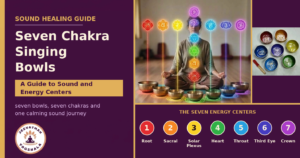
Sound healing is the practice of using tuned instruments and the human voice — singing bowls, gongs, tuning forks, chimes and chant — to shift the nervous system out of stress and into a rest state. It is not medicine and it does not cure disease. What it reliably does is slow the breath, quiet mental chatter and make deep relaxation easier to reach than it is in silence.
Key takeaways
- What sound healing is: structured listening to sustained, tuned sound designed to trigger a parasympathetic (rest-and-digest) response.
- How sound healing works: four plausible mechanisms — attention absorption, breath slowing, rhythmic entrainment and ritual expectancy.
- What the evidence supports: short-term reductions in self-reported tension, anxiety and low mood. Small studies, mostly without control groups.
- What it does not do: it does not “cure” cancer, “detox cells”, repair DNA or replace psychiatric or medical treatment.
- Who should be careful: people with epilepsy, severe tinnitus or hyperacusis, cochlear implants, first-trimester pregnancy, or acute psychosis.
What is sound healing?
Sound healing — also called sound therapy or vibrational sound therapy — is a relaxation practice in which a trained facilitator plays sustained, harmonically rich instruments while you lie still and listen. Sessions typically run 30 to 75 minutes. You do nothing except receive the sound. There is no posture to hold, no mantra to remember and nothing to get right.
The core idea is simple and worth stating plainly: long, unbroken tones give the mind something to rest on. A wandering mind hooks onto a decaying singing bowl note the way it hooks onto a candle flame. That absorption is the mechanism most likely doing the heavy lifting — not anything mystical about a specific number of hertz.
Sound healing vs sound bath vs music therapy
These three terms get used interchangeably and shouldn’t be. Here is the actual distinction:
| Practice | What it is | Who delivers it | Regulated? |
|---|---|---|---|
| Sound healing | Umbrella term for using tuned sound to induce relaxation and emotional release | Sound healers, yoga teachers, bodyworkers | No |
| Sound bath | A specific format — a group session where you lie down and are “bathed” in sound | Sound healers, studios, retreats | No |
| Music therapy | Clinical use of music toward assessed treatment goals, often with the patient playing or singing | Board-certified music therapists (MT-BC and equivalents) | Yes — credentialed profession |
| Nada Yoga | The classical Indian yogic discipline of sound as a path to absorption (samadhi) | Yoga teachers, traditional lineages | No |
If you want the group-session experience specifically, read our full guide to sound bath meditation and what to expect at your first session. Cleveland Clinic’s overview of sound baths is a useful outside reference point on what the format does and does not do.
How does sound healing work?
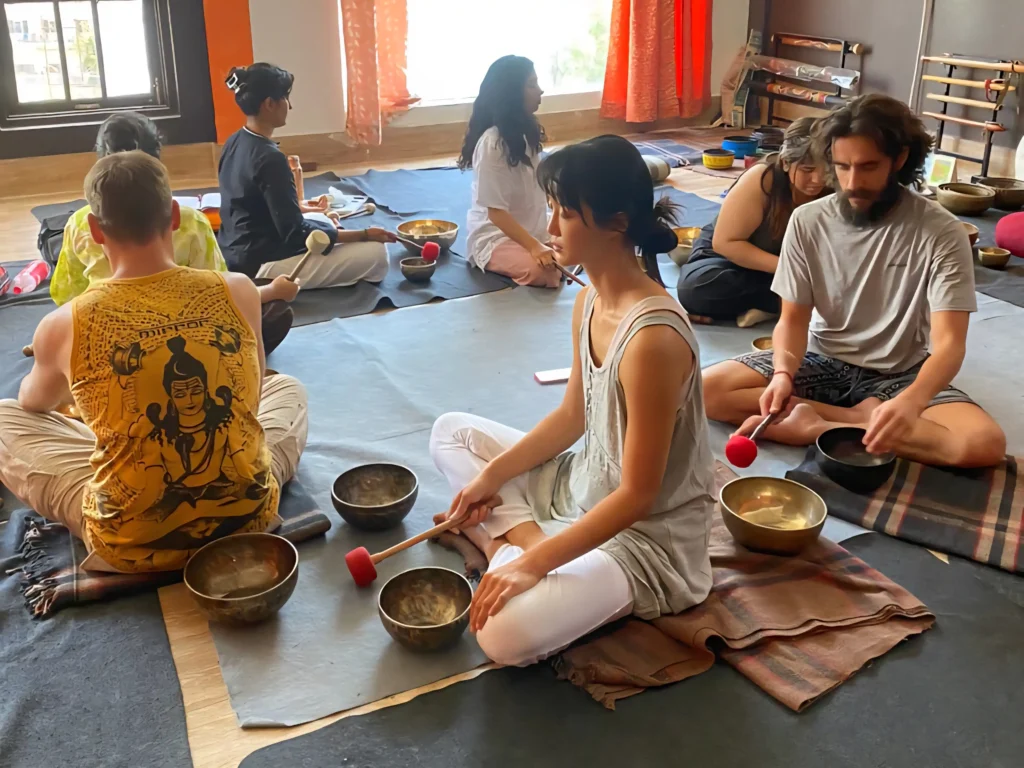
Sound healing works through four overlapping mechanisms, none of which require anything supernatural. Understanding them helps you get more from a session — and helps you spot practitioners making claims they cannot support.
1. Attention absorption
A struck singing bowl produces a tone that decays slowly over 30 to 90 seconds, with beating overtones that shimmer and shift. That complexity is unusually good at holding attention. When attention is occupied, the default mode network — the brain’s self-referential rumination circuit — quiets down. This is the same reason staring at moving water is calming.
2. Breath slowing and vagal tone
People unconsciously match their breathing to long tones. Slower exhalation stimulates the vagus nerve, which shifts the autonomic nervous system toward the parasympathetic branch: heart rate drops, digestion resumes, muscle tone releases. This is a well-documented physiological pathway, and it is almost certainly the main reason people feel different after a session. If your interest is the mental-health angle specifically, our article on yoga for mental health covers the same nervous-system territory from the asana side.
3. Rhythmic entrainment
Entrainment is the tendency of two oscillating systems to fall into sync. It is real physics — pendulum clocks on a shared wall synchronise. Applied to sound healing, the honest version of the claim is that slow acoustic pulses (the “beating” between two slightly detuned bowls, typically 4–8 beats per second) can nudge breath and attention rhythm. The overclaimed version — that a bowl “retunes your brainwaves to theta” — goes far beyond what the research shows.
4. Ritual, expectancy and safety
Lying down, being told nothing is required of you, and being held in a room by someone paying attention for an hour is itself therapeutic. Practitioners sometimes get defensive about this, as though it discounts the work. It doesn’t. Context effects are a genuine and powerful part of how any relaxation practice produces results.
What happens in your body during a sound healing session
Most people follow a fairly predictable arc. Here is the typical progression across a 60-minute session:
| Phase | Timing | What you notice |
|---|---|---|
| Settling | 0–10 min | Fidgeting, mental to-do lists, “am I doing this right?” |
| Physical release | 10–20 min | Jaw and shoulders drop, breath lengthens, occasional involuntary twitch or sigh |
| Drift state | 20–45 min | Hypnagogia — the border between waking and sleep. Time distortion, vivid imagery, brief micro-sleeps |
| Emotional surfacing | Any point | Unprompted tears, laughter, heat, or a memory arriving. Common and not a problem |
| Return | Final 10 min | Grogginess, thirst, a “wide” or spacious feeling that lasts a few hours |
Benefits of sound healing — and how strong the evidence is
The honest summary: the benefits of sound healing are real but modest, short-term, and studied in small samples. Most published work uses self-report questionnaires without control groups, which means expectancy effects are not ruled out. That is a genuine limitation, not a technicality.
The most cited work is an observational study by Goldsby and colleagues, published in 2017 in the Journal of Evidence-Based Complementary & Alternative Medicine, which followed 62 adults through singing bowl sound meditation and found significant reductions in reported tension, anger, fatigue and depressed mood, with larger effects in participants new to the practice. A 2025 systematic review in Integrative Medicine Research examined the clinical singing bowl literature and reached the same conclusion the honest practitioners already hold: promising signals, weak methodology, more rigorous trials needed. That verdict is not unique to sound work — the US National Center for Complementary and Integrative Health reaches much the same conclusion about relaxation techniques across the board.
| Claimed benefit | Evidence strength | Honest assessment |
|---|---|---|
| Reduced stress and anxiety | Moderate | Best-supported outcome. Consistent across small studies and mechanistically plausible |
| Improved mood, less fatigue | Moderate | Reported reliably; short-lived unless practised regularly |
| Easier sleep onset | Weak–moderate | Widely reported anecdotally; little controlled data specific to sound healing |
| Lower blood pressure / heart rate | Weak | Small acute changes measured, consistent with any deep relaxation. Not a hypertension treatment |
| Chronic pain relief | Weak | Some reduction in pain distress; no good evidence of change to the underlying condition |
| “Detoxifies cells”, “repairs DNA” | None | No supporting evidence. Treat any practitioner making these claims as a red flag |
| Treats cancer or serious illness | None | Dangerous claim. Sound healing may support quality of life alongside treatment — never instead of it |
Our students often arrive expecting the maximalist version of these claims. What we teach instead is what a facilitator can honestly promise: a reliable route to deep rest, and a container in which held emotion sometimes moves. That is enough. More on the practitioner side in what you actually gain from a sound healing teacher training.
Sound healing instruments and what each one does
Different instruments occupy different frequency bands and serve different functions inside a session. A skilled facilitator sequences them deliberately.
| Instrument | Character | Role in a session |
|---|---|---|
| Tibetan (metal) singing bowls | Complex, many overtones, warm | The workhorse. Opening, grounding, body placement |
| Crystal singing bowls | Pure, piercing, single dominant tone | Building intensity; can overwhelm sensitive listeners |
| Gong | Massive, chaotic, wall-of-sound | Peak of the arc. Most likely instrument to trigger emotional release |
| Tuning forks | Precise single pitch, weighted or unweighted | Targeted, close-to-body or on-body work |
| Koshi / wind chimes | Light, sparse, high register | Transitions and gentle return to waking |
| Voice, mantra and OM | Human, self-generated vibration | The oldest tool. Chanting engages the listener as a participant, not a recipient |
If you are choosing a first instrument, singing bowls are almost always the right entry point — our complete guide to Tibetan singing bowls covers types, sizes, playing technique and how to avoid buying a decorative bowl that will not sing.
Nada Yoga: the yogic root of sound healing
Nada Yoga — literally “the yoga of sound” — is the classical Indian framework that most modern sound healing quietly borrows from. It divides sound into ahata nada (struck sound, anything you can physically hear) and anahata nada (unstruck sound, the inner resonance perceived in deep meditation). The instruments are scaffolding. The destination is the inner sound.
This distinction matters practically. If you treat sound healing as something done to you, you plateau quickly. If you treat external sound as a doorway to internal listening, the practice keeps deepening for decades. That is the difference between attending sound baths and having a sound practice — and it is the framing we teach at our school in Rishikesh, where the practice of OM and inner sound sits at the centre of the syllabus rather than at the edge.
Who should be cautious with sound healing
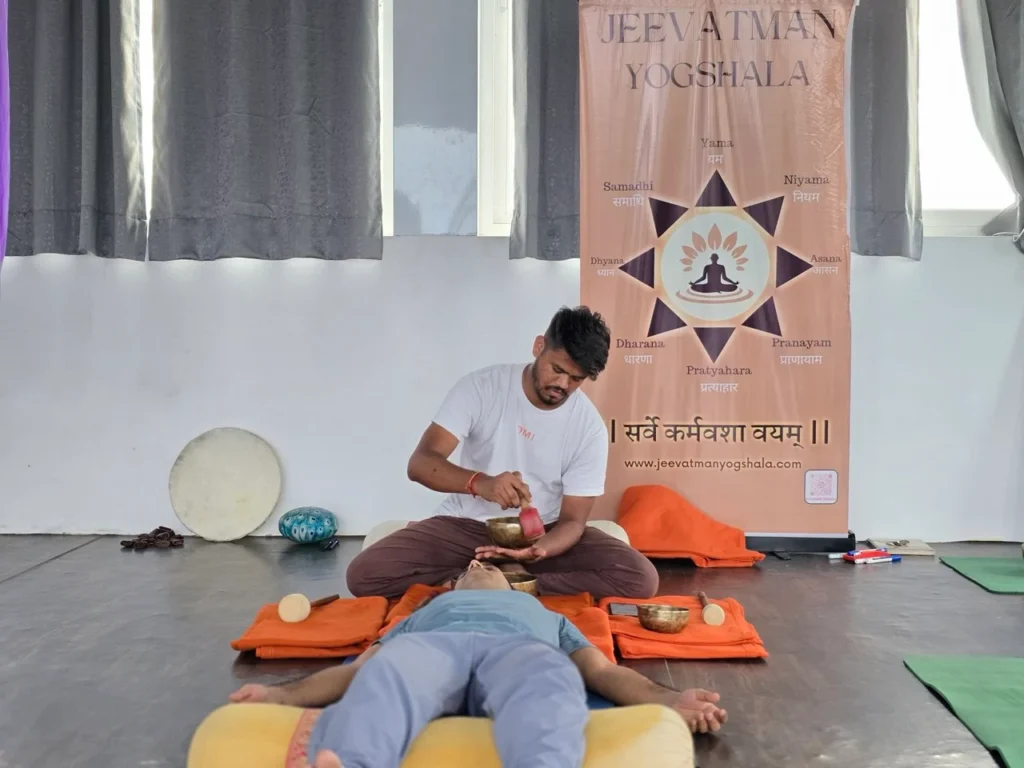
Sound healing is low-risk for most people, but “low-risk” is not “no-risk”, and honest practitioners screen. Speak to your doctor and tell your facilitator before a session if any of these apply:
- Epilepsy or seizure history — intense rhythmic or high-volume sound is a possible trigger. Gongs especially.
- Severe tinnitus, hyperacusis or Ménière’s disease — sustained loud overtones can aggravate symptoms.
- Cochlear implants or hearing aids — instruct the facilitator; volume perception differs sharply.
- First-trimester pregnancy — most teachers avoid placing bowls on the body and keep gongs at a distance. This is precaution, not established risk.
- Pacemakers or implanted devices — do not allow bowls to be placed directly on the body near the device.
- Acute psychosis, mania or dissociation — deeply altered states can destabilise. Sound healing is not a substitute for psychiatric care.
- Recent surgery or acute injury — no on-body bowl placement over the affected area.
A facilitator who does not ask about any of this before starting has not been trained properly. That is a reasonable filter to apply when choosing where to learn or where to attend.
Sound healing vs meditation — which should you do?
Sound healing is easier; meditation builds more. In a sound session the instrument does the work of holding your attention, which is why beginners often reach depth in one hour that took them months to find in silence. But that support is external. Remove the bowls and the skill does not necessarily remain.
Seated meditation is harder precisely because you supply the attention yourself — which is what trains it. The productive relationship is sequential: use sound to learn what a settled nervous system feels like, then use seated practice to learn to find that state without props. Most experienced practitioners run both.
How often should you practise sound healing?
For general stress management, one guided session a week plus 10–15 minutes of daily self-practice with a single bowl or voice is a realistic and effective rhythm. Effects from a single session typically last a few hours to two days. The durable changes people report — better sleep, lower baseline reactivity — come from consistency over weeks, not from intensity in one sitting. This is unglamorous and true of every contemplative practice.
Learning sound healing properly
There is no licensing body for sound healing anywhere in the world. Anyone can print a certificate. That means the burden of assessing quality falls on you, and the things worth checking are unromantic: how many supervised sessions you will facilitate, whether contraindication screening is taught, whether you learn to read a room rather than follow a script, and whether the instruments are yours to practise on daily.
Our sound healing course in Rishikesh is built around that list — instrument technique first, then session architecture, then supervised facilitation with real participants. It also pairs naturally with our 200-hour yoga teacher training for teachers who want to close a class with live sound rather than a recording, and with our 50-hour aerial yoga TTC with sound healing.
If your interest is professional rather than personal, the career path — instruments, insurance, pricing, building a client base — is laid out in our guide on how to become a sound healer. And for the historical and philosophical background, see the harmonious journey of sound healing.
Frequently asked questions about sound healing
Is sound healing scientifically proven?
No — not in the sense of having strong randomised controlled trial evidence. Small observational studies consistently show short-term reductions in self-reported tension, anxiety and low mood, and a 2025 systematic review of singing bowl studies confirmed the signal while criticising the methodology. It is best described as a plausible, low-risk relaxation practice with preliminary supporting evidence, not a proven medical treatment.
What does sound healing actually do to your body?
It shifts your autonomic nervous system toward the parasympathetic state. Practically: breathing slows and lengthens, heart rate drops, muscle tension in the jaw, shoulders and abdomen releases, and the brain’s rumination circuitry quiets as attention is absorbed by the sound. Most people also enter hypnagogia, the borderland between waking and sleep.
Can sound healing make you feel worse?
Occasionally, and it is usually not a sign something went wrong. Emotional surfacing — unexpected tears, agitation, old memories — is common, particularly during gong sections. Some people also get a mild headache or nausea from loud crystal bowls. If you leave sessions consistently distressed rather than settled, stop and speak to a mental health professional.
Is sound healing the same as a sound bath?
No. Sound healing is the broad practice; a sound bath is one specific format of it — a group session where participants lie down and receive continuous sound for 45–60 minutes. All sound baths are sound healing. Not all sound healing is a sound bath: one-to-one tuning fork work and on-body bowl therapy are not.
How long does a sound healing session last?
Group sound baths typically run 45 to 75 minutes. One-to-one sessions run 30 to 60 minutes. Anything under 20 minutes rarely gives the nervous system enough time to shift, and anything over 90 minutes tends to produce grogginess rather than added benefit.
Do you have to believe in sound healing for it to work?
No, but scepticism does reduce the effect somewhat — as it does with every relaxation practice. The physiological pathway (slowed breath, vagal activation) operates regardless of belief. The expectancy component does not. In practice, a sceptic who lies down and actually listens will still leave more relaxed than they arrived.
Can I do sound healing at home by myself?
Yes. A single medium singing bowl and 10 minutes is a legitimate daily practice: strike once, listen until the tone fully disappears, repeat. Self-practice with your own voice — a long, low OM — costs nothing and does much of the same work. Recordings are a weaker substitute because compression removes the overtone complexity that makes live sound absorbing.
What should I do after a sound healing session?
Drink water, avoid driving for 15–20 minutes, and do not schedule anything demanding immediately after. Many people feel spacious and slightly ungrounded for an hour or two. A short walk, food, and light physical activity restore normal alertness faster than lying down does.
Is sound healing suitable for children?
Generally yes for gentle bowl and chime work, with sessions shortened to 15–25 minutes and volume kept low. Gongs are usually avoided with young children. As with adults, screen for epilepsy and hearing sensitivity first.
Where is the best place to learn sound healing?
Look for a school where you facilitate supervised sessions rather than only observing, where contraindication screening is part of the syllabus, and where you have daily access to the instruments. Rishikesh remains the most common destination because sound work sits inside a living yogic context there rather than being taught as a standalone wellness modality — see our sound healing course in Rishikesh for how we structure it.