Quick answer: Start with one instrument, not five. Place sound at the end of class during savasana, keep it to 8–12 minutes, and never play a large gong or bowl directly on or beside a student’s head. Two instruments — a medium Tibetan bowl and a set of tingshas — are enough to run a credible closing sound bath. Once you can hold a room, a standalone 60–75 minute sound bath typically sells for 1.5–2.5× a regular class ticket.
Learning how to add sound healing to your yoga classes is one of the fastest ways to stand out on a studio roster. This is written for teachers who already hold a 200-hour certificate and are wondering whether sound is a genuine skill or a gimmick. Short version: it is a genuine skill, it is easy to do badly, and it is one of the few additions that both improves your classes and raises what you can charge. Here is how to do it properly.
Why teachers add sound — the honest business case
| What it does | Realistic effect |
|---|---|
| Differentiates you on a studio roster | High. Most studios have ten vinyasa teachers and no sound practitioner |
| Raises ticket price for a standalone event | High. Sound baths commonly price at 1.5–2.5× a drop-in class |
| Fills off-peak slots | High. Sunday evening and full-moon events sell when a 6pm flow will not |
| Improves retention in normal classes | Moderate. Students remember how savasana felt more than the standing sequence |
| Counts toward Yoga Alliance continuing education | Yes, if you train with a YACEP-registered provider |
| Opens corporate and private work | Moderate–high. Corporate wellness budgets book sound sessions readily |
What sound healing is — and what the evidence actually supports
Sound healing is the use of acoustic instruments and voice to guide the nervous system toward a rest state. In a yoga context it usually means a sound bath: students lie supported while the practitioner plays sustained tones.
Being straight about the evidence matters, because overclaiming is how practitioners lose credibility with the studios and clients who pay best:
- Reasonably supported: reductions in self-reported stress, tension and anxiety immediately after a session; improved subjective relaxation and sleep onset. The studies are mostly small and short-term, but they are consistent.
- Plausible mechanism: sustained, predictable tone plus stillness plus lying down promotes parasympathetic activity — the same broad mechanism as yoga nidra.
- Not supported: curing disease, “detoxing” organs, tuning specific frequencies to specific chakras as a physiological claim, or replacing medical treatment.
Teach it as what it is — a deep-rest practice with good subjective outcomes — and you will never have to walk a claim back.
Instruments to add sound healing to your yoga classes, in buying order
| # | Instrument | What it does in class | Buy this first? |
|---|---|---|---|
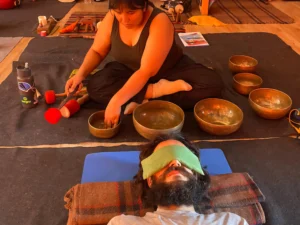
| 1 | Medium Tibetan singing bowl (approx. 15–20 cm) | Your workhorse. Opens and closes class, carries savasana | Yes — start here |
| 2 | Tingshas (small hand cymbals) | Marks transitions; brings students back from savasana without a jolt | Yes — cheap and immediately useful |
| 3 | Crystal (quartz) bowl | Purer, longer sustain; more penetrating than metal | Third purchase. Fragile and expensive to fly with |
| 4 | Ocean drum or rainstick | Texture and movement between sustained tones | Optional, low cost, high impact |
| 5 | Gong (symphonic or wind) | The centrepiece of a standalone sound bath | Only once you can hold a room. Loud, heavy, easy to misuse |
| 6 | Your own voice | Free, always with you, and the most underrated instrument on this list | Train it from day one |
The mistake almost every new practitioner makes: buying a gong and a full bowl set before learning to play one bowl well. A single well-struck bowl held for four minutes does more for a room than six instruments played nervously.
Where to add sound healing to your yoga classes: four placements
- Opening (1–2 minutes). One bowl strike, or three tingsha strikes, to mark the boundary between the street and the room. Do this before you speak.
- During long holds in yin or restorative (3–5 minutes). Sparse, widely spaced tones. Resist filling the silence — the silence is the practice.
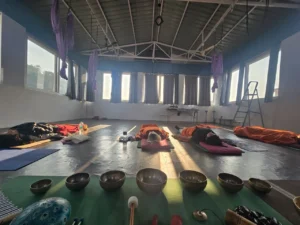
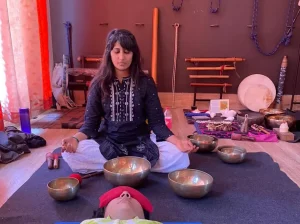
- Savasana (8–12 minutes). The highest-value placement, and where you should start. Sustained bowls, minimal variation, gradual decrease in volume toward the end.
- Closing (30 seconds). Tingshas to bring students back. Never a gong — it startles a nervous system you have just settled.
A simple 10-minute savasana sound structure
- 0:00–1:00 — Settle. Silence. Let students arrive in the pose before you play anything.
- 1:00–3:00 — One bowl, struck softly, allowed to decay fully before the next strike. Long gaps.
- 3:00–7:00 — Introduce a second tone. Overlap it with the first so the beats interact. Stay quiet in dynamic range.
- 7:00–9:00 — Thin out. Longer gaps, softer strikes. Signal the ending without announcing it.
- 9:00–10:00 — Silence, then three tingshas, spaced. Then your voice, quieter than usual.
Safety and contraindications — read this before you play for anyone
Sound is not risk-free, and knowing this is a mark of professionalism that studios notice.
- Pregnancy. Do not place bowls on the body. Keep loud, low-frequency instruments (gongs, large bowls) at a distance. Many practitioners avoid gong entirely in the first trimester.
- Epilepsy or seizure history. Sustained rhythmic sound can be a trigger for some people. Ask, and offer a seated position near the door.
- Tinnitus and hyperacusis. Keep volume moderate, avoid metallic high frequencies close to the head, and offer earplugs without making it awkward.
- Pacemakers and metal implants. Do not place vibrating bowls directly on the body.
- Recent surgery, acute injury, or fresh trauma. No bowls on the body; check in privately beforehand.
- Psychosis, dissociation, or active PTSD. Deep-rest states can be destabilising for some people. Keep the room lit dimly rather than dark, keep your voice present, and never lock a door.
- Volume. Gongs can exceed safe sustained exposure levels at close range. Distance and restraint are the whole skill.
Always run a quiet intake question before a standalone sound bath: “Is there anything — pregnancy, epilepsy, ear conditions, recent surgery — I should know about?” Ask it once, warmly, and move on.
What to charge once you add sound healing to your yoga classes
| Format | Typical pricing logic |
|---|---|
| Sound in your existing class | No surcharge. It raises retention and referrals instead |
| Standalone group sound bath (60–75 min) | 1.5–2.5× your studio’s drop-in rate |
| Full moon / seasonal event | Premium ticket; these sell out fastest |
| 1:1 session | Priced like a private yoga session or slightly above |
| Corporate / workplace | Flat session fee plus travel; the highest-margin work available |
| Yoga + sound retreat day | Day-rate pricing; strongest margin per hour of the lot |
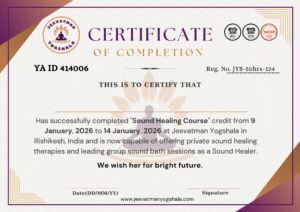
Two practical notes. First, check your insurance — confirm with your provider that sound work falls within your existing policy or needs an add-on. Second, a certificate helps you get booked, not to practise. Studios, corporates and event organisers ask for training credentials; a YACEP-registered certificate answers that question and simultaneously counts toward the Yoga Alliance continuing education you need to keep your RYT current.
What we notice teaching this in Rishikesh
Ayushi Desai teaches our sound healing and yoga nidra sessions, and the correction she gives most often has nothing to do with instruments. It is this: new practitioners play too much. They fill every gap because silence feels like failure. But the effect happens in the decay — in the space after the strike, where the room settles a little deeper each time.
The second most common correction: practitioners forget they are in the room. Students track your nervous system whether you like it or not. If you are anxious about the next transition, they feel it. This is why we teach sound alongside pranayama and yoga nidra rather than as a standalone instrument workshop — your own regulation is the instrument that matters most.
The third: most teachers underestimate how quickly this becomes bookable work. Graduates regularly report running their first paid sound bath within weeks of getting home, because a studio’s roster is full of flow teachers and empty of sound practitioners.
A 30-day plan to get from zero to your first sound bath
- Days 1–7. Buy one medium bowl and tingshas. Play the bowl for ten minutes daily. Learn strike, rim, and how long the decay actually lasts.
- Days 8–14. Add three minutes of sound to savasana in your existing classes. Say nothing about it. Watch what happens.
- Days 15–21. Extend to a full 8–10 minute savasana sound. Ask two trusted students for blunt feedback.
- Days 22–30. Take a structured, YACEP-registered training to fill the gaps you now know you have — layering, intake, safety, and holding a 60-minute arc. Then pitch a one-off evening event to your studio.
Frequently asked questions
Do I need a certification to run sound baths?
No law requires it in most countries. In practice, studios, retreat companies, corporate clients and insurers ask for training credentials, so a certificate is what gets you booked. A YACEP-registered course has the added benefit of counting toward Yoga Alliance continuing education.
Can I do sound healing training without being a yoga teacher?
Yes. Our sound healing course accepts complete beginners as well as certified teachers — see how to become a sound healer for the full pathway.
Which bowl should I buy first — Tibetan or crystal?
Tibetan. It is more durable, more forgiving to play, cheaper, and survives air travel. Crystal bowls are beautiful and fragile; buy one once you know what note you want and why.
How long should a sound bath be?
Inside a yoga class, 8–12 minutes in savasana. As a standalone event, 45–75 minutes including settling and a slow return. Longer is not better — attention degrades and bodies get uncomfortable on a mat past about 75 minutes.
Do the specific frequencies matter?
Less than practitioners claim. The Solfeggio frequencies and the 432 Hz debate are interesting cultural history and useful marketing language, but the evidence for frequency-specific physiological effects is thin. What reliably matters is sustained tone, predictability, volume control and silence. We go into the detail in our Solfeggio frequencies guide.
Can I place bowls directly on a student’s body?
Only with training, explicit consent, and never over pregnancy, implants, recent surgery, or the head. When in doubt, play beside the body rather than on it.
How long does it take to learn?
You can add credible sound to savasana within a month of daily practice. Holding a full standalone sound bath with multiple instruments and a proper intake process is what a structured course accelerates — most people cover that ground in a focused week rather than a self-taught year.
Related reading
- What is sound healing? How it works, benefits and what the evidence says
- Tibetan singing bowls: types, benefits and how to play one
- Sound bath meditation: what to expect at your first session
- Top 5 benefits of joining a sound healing teacher training course
- Keeping your RYT current: registration and continuing education
Train with us in Rishikesh
Sound Healing Course (YACEP)
Flexible 1–7 day formats · Tibetan and crystal bowls, gong, tingshas, voice · yoga nidra integration · safety and intake protocol · counts toward Yoga Alliance continuing education. Taught by Ayushi Desai.
From US$120 (shared) · US$235 (private room)
50-Hour Aerial + Sound Healing
Six days combining aerial yoga teacher training with sound healing — two additions to your teaching offer in under a week.
From US$450
Already teaching and want to add sound? Tell us how many days you have and what you already own — we will tell you which format actually fits, or tell you to save your money if a shorter option would do.
WhatsApp: +91 8169 145 495 · jeevatmanyogshala@gmail.com · Contact us
About the school. Jeevatman Yogshala is a Yoga Alliance registered school (RYS 200, RYS 300, RYS 500, YACEP) in Swargashram, Rishikesh, India. Sound healing and yoga nidra are taught by Ayushi Desai. Health note: sound healing is a relaxation practice. It is not a treatment for any medical or psychiatric condition and should not replace medical care. If you are pregnant, have epilepsy, a pacemaker, an ear condition, or a mental health condition, speak to your doctor and tell your practitioner before attending.
Last reviewed: September 2026.