
Quick answer: In the US, PayScale reports an average yoga instructor hourly rate of about US$28, ranging from roughly US$15 to US$60. But hourly rate is the wrong number to plan with: almost no teacher earns a living from studio classes alone. Teachers who reach a full income do it by stacking three or four streams — studio classes, privates, a specialism such as sound healing, corporate work and retreats. Expect year one to be part-time.
Yoga teacher salary is the number every trainee wants before they book. Most articles on this topic are written by schools with an obvious interest in the answer being “loads.” We run a training school, so we have the same conflict of interest. We are going to give you the unflattering version anyway, because the students who succeed are the ones who went in with accurate expectations.
Yoga teacher salary by country: what teachers actually earn
| Country | Typical pay per group class | Typical private session | Notes |
|---|---|---|---|
| United States | US$28/hr average per PayScale; US$15–60 range | US$75–150+ | Many studios pay a base plus a per-head bonus |
| United Kingdom | £25–45 | £50–90 | Council and leisure-centre contracts pay lower but book reliably |
| Canada | C$35–60 | C$80–140 | Similar structure to the US |
| Australia | A$45–80 | A$90–160 | Higher rates, higher cost of living; CPR and First Aid usually required |
| Western Europe | €25–50 | €60–110 | Self-employment registration is often mandatory before you can invoice |
| UAE / Gulf | AED 150–350 | AED 300–600 | Strong rates; local instructor permits and attested documents required |
| India | ₹500–2,000 | ₹1,000–3,000 | Resident-teacher roles at schools and resorts often include food and lodging |
US figures from PayScale’s 2026 yoga instructor data. Other figures are commonly reported market ranges, not survey data — treat them as a planning guide and verify locally.
Why the hourly yoga teacher salary figure misleads almost everyone
A US$40 class does not mean US$40 an hour of work. Count what a class actually costs you:
- Sequencing and planning: 20–40 minutes early on, less as you build a library
- Travel: often 40–60 minutes round trip, unpaid
- Arriving early and staying late: 30 minutes, unpaid, and non-negotiable if you want to build a following
- Admin, marketing, insurance, CE hours: ongoing, unpaid
A US$40 class is realistically closer to US$16–20 per hour of committed time in your first year. That number improves fast — once you have a repertoire and a home studio you no longer travel to, the same class costs you half the time.
The five income streams that actually change the maths
| Stream | Effort to start | Earning ceiling | How soon after your 200-hour |
|---|---|---|---|
| Studio group classes | Low | Low | Immediately — this is your training ground |
| Private clients | Moderate | High | Month 2–6, usually from your own class students |
| A specialism (sound healing, yin, prenatal, aerial) | Moderate | High | As soon as you are certified — the fastest differentiator |
| Corporate and workplace sessions | Moderate | Very high per hour | Month 6+, once you have a track record to point at |
| Retreats, workshops and events | High | Very high | Year 2+, once you have an audience to sell to |
The pattern in every sustainable yoga career we have watched: group classes build the audience; everything else monetises it. Teachers who treat group classes as the destination plateau. Teachers who treat them as a funnel do not.
Why a specialism moves your rate more than more hours do
There is a common assumption that a 300-hour or 500-hour training is the route to earning more. Sometimes it is — it deepens your teaching and opens senior roles. But in pure rate terms, a distinct skill usually beats more general hours, for a simple supply reason.
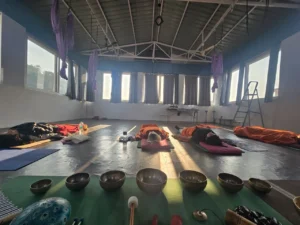
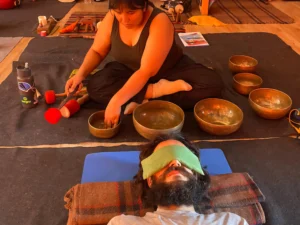
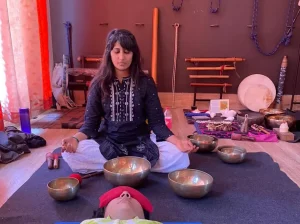
A studio roster typically has ten or more teachers who can lead a vinyasa class. It usually has nobody who can run a sound bath, a yoga nidra evening, or a prenatal series. When the studio wants to fill a Sunday evening or launch a workshop, they cannot call the ten. They call the one.
This is why we suggest students stack a short specialism onto their trip rather than saving it for later:
- A standalone sound bath commonly tickets at 1.5–2.5× a drop-in class, for the same room and the same hour
- Corporate wellness budgets book sound and breathwork sessions readily, at flat session fees rather than per-head rates
- A specialism gives you a reason to be booked rather than a request to be added to a waiting list
- A YACEP-registered course simultaneously covers the continuing education hours you need to keep your RYT active
The cost logic is stark. Taking a sound healing certification at home later is typically a four-figure decision. Added onto a trip you are already making — our sound healing course starts at US$120 — it is a rounding error on your flight.
Is a 200-hour training worth the money? The honest calculation
Take our own numbers, because we can be precise about them rather than hypothetical.
| Item | Cost |
|---|---|
| 200-hour YTT in Rishikesh, 22 days, accommodation and all meals included | US$950 |
| Return flights (varies widely by origin) | US$600–1,200 |
| Visa, insurance, incidentals | US$150–250 |
| Yoga Alliance RYT registration and first-year dues | Approx. US$115–165 |
| Liability insurance at home, year one | US$150–300 |
| Realistic all-in total | US$2,000–2,900 |
At an average US rate of roughly US$28 per class hour, that total is repaid by somewhere between 70 and 105 taught classes. At two classes a week, that is under a year. At four, roughly six months. Add one weekly private client at US$90 and it compresses sharply.
The honest caveat: this maths only works if you actually teach. A large share of 200-hour graduates never teach a paid class — not because the certificate failed, but because they finished the course, went home, waited to feel ready, and never taught. The single highest-return action after your training is teaching your first free class within two weeks of landing, to friends, in a park. Momentum is the variable, not the certificate.
And if you are doing the training for your own practice rather than a career — which is true of a meaningful share of our students — then the ROI question does not apply. A three-week immersion is not expensive measured against three weeks of anything else.
Practical tips for earning more, in order of impact
- Teach within two weeks of getting home. Free, badly, to friends. Waiting to feel ready is the most expensive habit in this profession.
- Collect emails from day one. Your list is the only asset that survives changing studios. A studio owns its students; you own your list.
- Convert group students into privates. The highest-margin work available to a new teacher, and it comes from people who already know you.
- Add one specialism, not three. Depth in one differentiator beats being vaguely qualified in several.
- Pitch one local business. A single weekly corporate session often out-earns three studio classes.
- Raise your private rate annually. Most teachers never do, and quietly lose ground to inflation for a decade.
- Track continuing education as you go. Scrambling for CE hours at renewal is more expensive than planning them.
Yoga teacher salary: frequently asked questions
Can you make a full-time living as a yoga teacher?
Yes, and many people do — but almost never from group studio classes alone. Full-time incomes are built from a mix of classes, privates, a specialism, corporate work and events. Plan for year one to be part-time alongside other income.
How much do yoga teachers make in their first year?
Realistically, part-time money. Two to four classes a week at typical rates is a supplementary income, not a salary. The teachers who scale past that in year two are the ones who built a private client base and one specialism in year one.
Is a 300-hour training worth it for earning more?
It deepens your teaching and opens senior and mentoring roles, but it does not automatically raise your class rate. If income is the goal, a specialism usually moves the number faster. Our comparison: 200-hour vs 300-hour — which do you actually need?
Do I need to register as an RYT to get paid?
Not legally in most countries, but many job adverts list it as a minimum, so it removes friction. See how to register as an RYT 200.
Will a certificate from India let me earn the same as one from home?
Yes — pay is set by your local market and your ability to fill a room, not by where you trained. What matters is that the school is a Registered Yoga School. We cover the country-by-country detail in is an Indian 200-hour certification valid abroad?
What is the fastest way to raise my rate?
Move students into privates, and add one specialism that your local studios do not already have on the roster. Sound healing is the clearest example — see how to add sound healing to your yoga classes.
Related reading
- What a 200-hour YTT in Rishikesh costs in 2026
- Rishikesh vs Bali vs Costa Rica vs Goa: where to train
- Can a complete beginner do a 200-hour YTT?
- How to start a yoga class: setting the tone from the first minute
Start the maths
200-Hour Yoga Teacher Training
22 days · Yoga Alliance RYS 200 · Hatha & Ashtanga Vinyasa · accommodation and all sattvic meals included · batches of 14–17 with repeated supervised teaching practice.
US$950 shared · US$1,150 private room
Sound Healing Course (YACEP)
1–7 days · the fastest way to add a differentiator studios do not already have on the roster · counts toward Yoga Alliance continuing education.
From US$120
Want the numbers for your own situation? Tell us your country, how many hours a week you could realistically teach, and what you already hold. We will sketch the maths honestly — including if the answer is that now is not the right time.
WhatsApp: +91 8169 145 495 · jeevatmanyogshala@gmail.com · Contact us
About Jeevatman Yogshala. Yoga Alliance registered school (RYS 200, RYS 300, RYS 500, YACEP) in Swargashram, Rishikesh, India. US hourly figures are from PayScale’s 2026 yoga instructor research; other country figures are commonly reported market ranges provided for planning purposes and are not survey data. Nothing here is financial advice — your earnings depend on your market, your hours and your effort.
Last reviewed: September 2026.