Quick answer: Choose Rishikesh for traditional philosophy, pranayama and the lowest cost per contact hour. Choose Bali for modern vinyasa, Instagram-ready settings and an easier first trip to Asia. Choose Costa Rica if you are North American and want a short flight with a nature-immersion feel. Choose Goa if you want India’s syllabus with a beach-and-nightlife social life. The cost gap is real: the same 200 hours runs roughly US$950 in Rishikesh and US$3,000+ in Costa Rica.
Deciding where to do yoga teacher training is mostly a question of budget, style and tolerance for discomfort. We run trainings in Rishikesh, so treat the sections below with the appropriate scepticism — and note that we have written the honest downsides of our own city rather than skipping them. If Rishikesh is wrong for you, we would rather you find that out here than after you have paid a deposit.
Where to do yoga teacher training: the comparison table
| Rishikesh, India | Bali, Indonesia | Costa Rica | Goa, India | |
|---|---|---|---|---|
| Typical advertised 200-hr cost | US$800–1,600 usually all-inclusive | US$1,600–3,500 | US$2,500–4,500 | US$1,100–2,200 |
| Usually includes food + room? | Yes, nearly always | Sometimes; often room only | Usually, at a premium | Usually |
| Dominant style taught | Hatha, Ashtanga Vinyasa | Vinyasa, Yin | Vinyasa, Yin | Hatha, Ashtanga, Vinyasa |
| Philosophy & pranayama depth | Highest | Moderate | Light | Moderate–high |
| Alcohol / party culture | None — Rishikesh is legally dry and vegetarian | Present, easy to avoid or find | Present | Very present |
| Best season | Sept–Nov, Feb–Apr | Apr–Oct (dry) | Dec–Apr (dry) | Nov–Mar |
| Flight cost from Europe | Low–moderate | Moderate–high | High | Low–moderate |
| Flight cost from North America | High | High | Low | High |
| Visa friction | Moderate — plan ahead | Low | Very low for US/EU | Moderate — same as Rishikesh |
| Realistic total budget incl. flights | US$1,700–2,800 | US$2,800–5,000 | US$3,200–6,000 | US$2,000–3,500 |
Cost ranges reflect commonly advertised prices for Yoga Alliance registered 200-hour courses in 2026. Always confirm current pricing and what is included directly with the school.
Cost per contact hour: the number nobody publishes
Course price alone is misleading, because some schools include everything and others charge separately for accommodation, food, materials and the certificate. The useful comparison is all-in cost divided by 200 hours.
- Rishikesh, all-inclusive at US$950: about US$4.75 per contact hour, with room and three sattvic meals a day inside that figure.
- Bali at US$2,400 course-only, plus roughly US$900 for 3–4 weeks of food and a room: about US$16.50 per hour.
- Costa Rica at US$3,200 all-inclusive: about US$16 per hour.
That is a three-fold difference for a syllabus that must meet the same Yoga Alliance standard in all three places. The difference buys you climate, comfort and proximity — not more curriculum.
Rishikesh: what it is genuinely good at, and who should not come
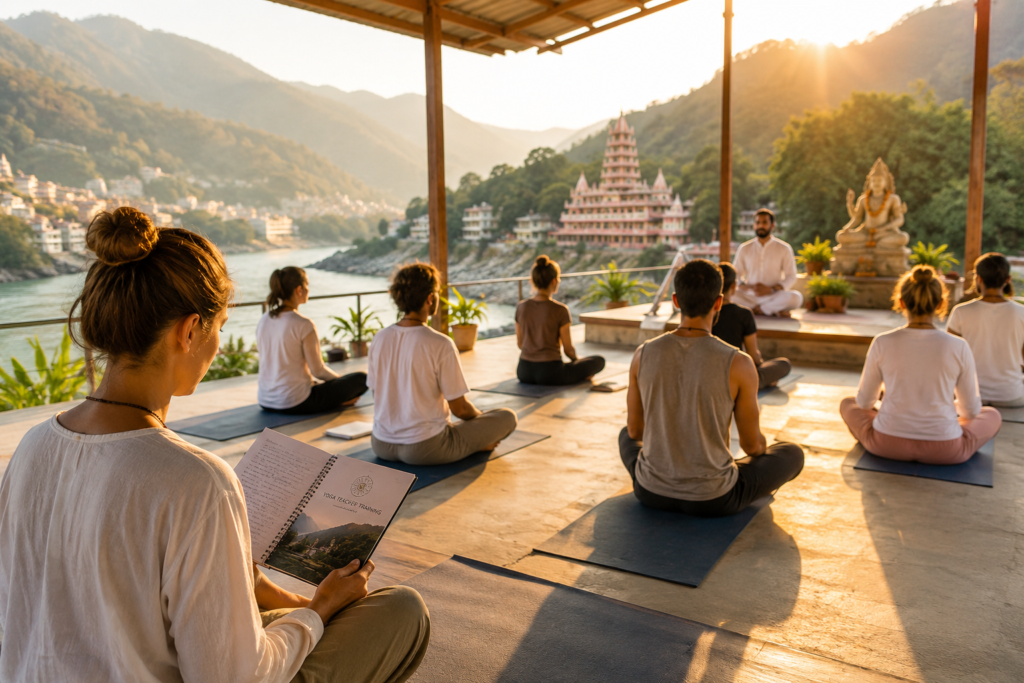
Good at: philosophy, Sanskrit, pranayama and meditation taught by people who learned them as a lineage rather than a module. The Ganges, the ashram culture and the absence of alcohol create an environment that does most of the discipline work for you. It is also, by a distance, the best value in the world for a registered 200-hour.
Not good for you if: you want comfort. Rooms are simple. The town is loud, crowded, and full of monkeys that will take your snacks. There is no beach and no bar. Digestive adjustment is common in the first three or four days for most Western visitors. Summer (May–June) is genuinely hot and the monsoon (July–August) is heavy.
If reading that made you slightly uneasy, Rishikesh may still be right — most of our students say the discomfort was the point. If it made you certain, Bali is the better call and we would say so on a call.
Bali: what it is genuinely good at
Good at: modern vinyasa sequencing, a soft landing for a first long trip in Asia, excellent cafés and a large community of Western teachers you can network with. Ubud in particular has an ecosystem — studios, workshops, retreat companies — where you can pick up teaching experience quickly after graduating.
Weaker at: philosophy and pranayama depth, which are often compressed. Costs escalate quietly through the month via food, scooters and extras. Quality varies enormously between schools; the marketing gloss is thicker than anywhere else on this list.
Costa Rica: what it is genuinely good at
Good at: short flights and low friction for North Americans, jungle-and-ocean settings, small groups, and a well-organised, professionalised delivery. Time zone overlap means you can stay in touch with home easily.
Weaker at: price. You are paying roughly three times the Indian rate for the same registered hours. The traditional and philosophical content is usually the lightest of the four.
Goa: what it is genuinely good at
Good at: Indian syllabus with a social, beachside life. Warmer and more relaxed than Rishikesh, with the same broad curriculum tradition, and cheaper than Bali.
Weaker at: focus. The same nightlife that makes Goa fun makes a 5:30am pranayama class harder to sustain for 22 straight days. Season is short — outside November to March the weather works against you.
How to choose where to do yoga teacher training: four questions
- What is your real all-in budget, flights included? Under US$3,000 from Europe or Asia points strongly to India. North Americans with a US$5,000 budget can legitimately choose any of the four.
- Do you want to learn to teach, or to practise? If you want a career, weight teaching practicum hours and class-size limits above the setting. Ask every school: how many times will I actually teach the group?
- Which style do you want on your certificate? If you want to teach flow classes in a Western studio, a vinyasa-heavy course helps. If you want depth in philosophy and breath, India is where that is taught natively.
- How much discomfort can you productively tolerate? This is the question people answer dishonestly. Be honest with yourself; a course you drop out of is the most expensive option of all.
An observation from running these courses
Across our batches, the students who get the most out of a training are almost never the ones with the strongest asana practice on day one. They are the ones who came for a reason they could articulate — a career change, a recovery, a decision they were avoiding at home.
The practical version of that: the destination matters far less than whether the school makes you teach. Two hundred hours of being taught produces a good student. Two hundred hours that include repeated, corrected teaching practice in front of peers produces a teacher. When you compare schools in any of these four places, that is the question to lead with — not the pool photos.
We keep batches to roughly 14–17 people for this reason. Above about 25, individual teaching feedback becomes arithmetic rather than instruction.
Practical tips whichever destination you pick
- Verify the RYS registration yourself in the Yoga Alliance directory before paying. This applies equally in Bali and Costa Rica — an unregistered school is a bad buy anywhere. See our guide on whether an Indian certificate is valid abroad for the five-minute check.
- Ask for the daily schedule in writing. Count the actual instruction hours. Some “200-hour” courses count your own self-practice and free time toward the total.
- Ask how many students are in the batch, and how many times each student teaches.
- Read reviews outside the school’s own website. Google Business and community groups are less curated.
- Buy travel insurance that covers course cancellation, not just medical.
- Sort your visa early. India’s requirements are the strictest of the four — see our India yoga training visa guide.
Frequently asked questions
Is Rishikesh really cheaper, or is the quality lower?
It is genuinely cheaper, because local costs — staff, food, accommodation, property — are a fraction of Bali’s or Costa Rica’s. The Yoga Alliance curriculum standard is the same. What you give up is comfort and scenery, not contact hours.
Which destination is best for a complete beginner?
All four accept beginners, and a beginner can complete a 200-hour anywhere. The more useful filter is class size and whether the school offers alignment support. We cover this in can a complete beginner do a 200-hour YTT.
Is Rishikesh safe for solo female travellers?
Broadly yes, with sensible precautions, and the majority of our students are women travelling alone. We have written an honest, unromanticised guide: is Rishikesh safe for solo female travellers.
Can I do a 200-hour and a specialism in the same trip?
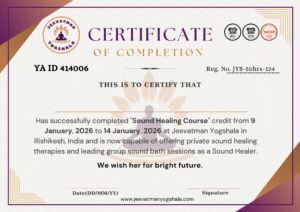
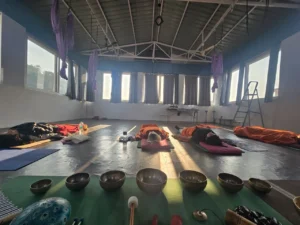
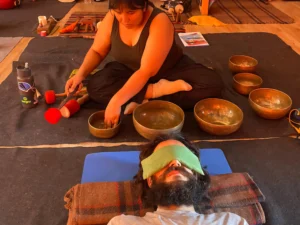
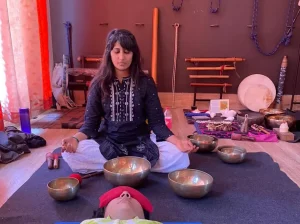
Yes, and it is the single best value decision available in India. Adding a short sound healing, yin or aerial certification to the same trip costs a fraction of doing it separately later at home, and gives you something distinct to offer studios. See the sound healing course and 50-hour yin training.
When is the best month to train in Rishikesh?
September to November and February to April. Full breakdown in our month-by-month guide.
What should I actually pack?
Less than you think, and a few things you would not guess. See what to pack for yoga teacher training in Rishikesh.
Related reading
- How much does a 200-hour YTT in Rishikesh cost in 2026?
- The hour-by-hour daily schedule of a 200-hour YTT
- Hatha vs Ashtanga: which style suits your 200-hour?
- How to choose a 200-hour YTT in Rishikesh
If Rishikesh is your answer
200-Hour Yoga Teacher Training
22 days · Yoga Alliance RYS 200 · Hatha & Ashtanga Vinyasa · accommodation, sattvic meals and materials included · batches of 14–17 · Swargashram, Rishikesh.
US$950 shared · US$1,150 private room
Add a specialism to the same trip
Sound healing (1–7 days, YACEP), 50-hour aerial, or 50-hour yin — stacked onto your 200-hour so you fly home with more than one certificate.
Sound healing from US$120
Not sure Rishikesh is right for you? Tell us your budget, your home country and what you want to do after the course. If another destination suits you better, we will say so.
WhatsApp: +91 8169 145 495 · jeevatmanyogshala@gmail.com · Book a call in your timezone
About Jeevatman Yogshala. Yoga Alliance registered school (RYS 200, RYS 300, RYS 500, YACEP) in Swargashram, Rishikesh, India. Costs quoted for other destinations are commonly advertised 2026 ranges gathered from public course listings and are indicative only.
Last reviewed: September 2026.