Rishikesh has dozens of schools offering a 200 hour yoga teacher training. They do not all deliver the same experience. Some will change your practice, your teaching, and quietly rearrange your life. Others will leave you feeling like you paid a lot of money for a month of yoga classes that never quiet when deep enough.
The difference comes down to seven criteria. Evaluate school against these before you book anything.
The 7-point checklist
What to Look for in a Yoga School in Rishikesh
- Accreditation: Is this school registered with Yoga Alliance USA as an RYS 200?
- Batch size: How many students for group? Fewer than 20 is good. Fewer than 15 is better.
- Teacher credentials: Who actually teaches and for how many years have they practiced and taught?
- What’s included: Does the fee cover accommodation, meals, materials and certification?
- Reviews: Are there real identifiable graduate reviews; with names, countries and specific experiences?
- Location: Is the school in a quiet, river-close setting that supports deep immersion?
- Refund policy: Is there are clear, written cancellation and refund policy before you pay a deposit?
Each of these criteria matters for a specific reason. Here is what to look for and what to watch out for in each one.
1. Accreditation - Verify It Yourself
The single most important thing to confirm is whether the school is registered with Yoga Alliance USA as a Register Yoga School (RYS 200). This is not a formality. It is the difference between a certificate with international professional weight and one that carries no recognition outside the country where you earned it.
You can verify any school’s registration directly on the Yoga Alliance website search by school name. If the school is registered, it appears in the directory with its registration date and current status.
Watch out for these phrases, they sound official but mean nothing:
- “Yoga Alliance addiliated”
- “Yoga Alliance approved”
- “Internationally recognised”
The only phrase that matters is Registered Yoga School (RYS 200). Ask for the registration number. Check it.
At Jeevatman Yogshala: We are Yoga Alliance USA registered RYS 200. Our graduates register as RYT-200 upon completion and can teach Internationally.
2. Batch Size - Smaller Is Almost Always Better
Batch size is one of the clearest indicators of the quality of personal attention you will receive. Personal attention is what makes a yoga teacher training genuinely transformative rather than just intensive.
Many schools in Rishikesh run batches of 30, 40, even 60 students. From a business perspective this makes sense. From a learning perspective it is a serious compromise. In a group of 40 a teacher cannot watch your alignment in Trikonasana, cannot notice the way you are collapsing your left hip in Warrior II, cannot sit with you after philosophy class when something cracked open.
Look for school that cap patches at 15 to 20 students maximum. Schools that cap at 12 to 15 are better still. This will usually mean slightly higher price. It is worth the difference.
At Jeevatman Yogshala: We cap every batch at 15 students. This is a deliberate choice, not a circumstance. Small groups are the only way to teach what we want to teach.
3. Teacher Credentials - Research the Actual People
The quality of a yoga teacher training is, ultimately, the quality of its teachers. This is obvious, and yet it is the criterion most people skip when comparing schools. They look at the website, the photos, the price. They rarely research the specific individuals who will be in the room with them every day for a month.
Before choosing any school, research its lead teachers specifically. Ask:
- How many years have they been in practicing? How many years teaching?
- Where did they train? Who were their teachers?
- Do they have a consistent personal practice, not just a teaching career?
- What is their teaching philosophy? Does it come from lived experience or from curriculum?
- Are they actually present for most of the training, or do they hand it to junior teachers?
“We only teach what we have lived. Not what we have read, not what we were taught in a training, not what looks good on a syllabus. Every thing we bring to the mat has moved through our own body first.” – Teachers of Jeevatman Yogshala
The best teachers teach from genuine experience of the practice as a living thing not as a curriculum to be delivered. That quality of transmission is the difference between a yoga course and a yoga transformation.
4. What's Included - Read The Fine Print
The listed price of a 200 Hour YTT in Rishikesh ranges from around $700 $2,500 USD. Never compare numbers without comparing what those numbers cover.
A fair all inclusive residential 200 Hour YTT should cover:
- Accommodation for the full duration of the course.
- Satvik vegetarian meals per day.
- All course materials and textbooks.
- Yoga Alliance registration support and certification.
- All class sessions – Asana, Philosophy, Anatomy, Methodology, Meditation.
Ask for a line-by-line breakdown of inclusions and exclusions in writing before paying any deposit.
5. Reviews - Look for Real Graduates, Not Numbers
Star ratings mean nothing on that own. A school can have a 4.9 average from 200 reviews and still deliver a mediocre training. If the reviews are generic, unverified, or incentivised.
What to look for in reviews:
- Real name and countries not anonymous or initials-only
- specific experiences, mentions of particular teachers, philosophy sessions, moments that shifted something
- Honest texture, genuine reviews mention what was hard not just what was beautiful
- Multiple platforms – Google, BookRetreats, BookYogaRetreats, not just the school’s own website
6. Location - Where You Train Shapes How You Train
Rishikesh is not one place. It spans several kilometres along the Maa Ganga with distinct neighbourhoods that have very different characters. For a serious residential yoga teacher training, location within Rishikesh matters significantly.
- Ram Jhula / Jonk Village area: Quieter, Village-like, closer to the river and forest. Small lanes, temple bells at Dawn, the Maa Ganga at a few minutes’ walk. This is the environment that supports deep immersion.
- Tapovan: More international, more cafes and activities. Better for social experience, less suited to an intensive residential training.
- Town Centre: Urban, noisy, traffic. Not the right environment for a month of internal work.
For a 200 hour YTT, you want to wake up to rivers sounds, not traffic. You want the atmosphere of a place that takes spiritual practice seriously. Ask where the school is specifically located, not just “Rishikesh.”
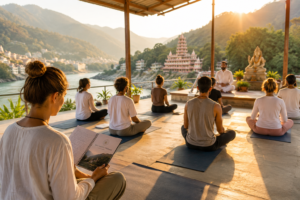
At Jeevatman Yogshala: We are located in Jonk village, Ram Jhula. A quiet river-close neighbourhood where you wake up to the Maa Ganga and Temple bells. It is deliberately not the busiest part of Rishikesh. That is the point.
7. Refund Policy - Get It in Writing Before You Pay
This criterion get overlooked until it matters. Then it matters a great deal. Life changes. Plans shift. Before paying any deposit, ask for the complete cancellation and refund policy in writing.
Specifically ask:
- What percentage of the fee is refundable if I cancel 60 days before the court starts?
- What percentage if I cancel 30 days before? 14 days before?
- Can I transfer my booking to a future batch if I need to reschedule?
- What happens if the school cancels or reschedules a batch?
A school with a fair, clearly stated refund policy is a school that trusts itself. Vague or verbal refund policies are a warning sign.
🚩 Red Flags: Walk Away From These
- No verifiable Yoga Alliance registration. Check it yourself do not take the school’s word for it.
- Batch sizes over 20 students. You will not receive adequate personal attention.
- Teacher bios with no depth, no years of experience listed, no photos. If you cannot find out who is teaching you, be cautious.
- Curriculum that is vague. “We cover all aspecs of yoga” is not a curriculum. Ask for a day by day schedule.
- No Reviews from a real, named graduates with specific experience is described.
- Prices significantly below $700 USD all-inclusive. A quality residential YTT with experienced teachers, real accommodation, and proper food cannot be delivered before this threshold. Ask what is being cut.
- Pressure to book Immediately. A school that is confident in its quality does not need to rush you.
- No Written Refund Policy. Ask for it before paying anything.
Questions to Ask Every School Before You Book
Send these directly. The quality and speed of the response will tell you as much as the answer themselves.
- What is your Yoga Alliance RYS 200 registration number?
- Who are the lead teachers, and how many years have they been practicing and teaching?
- What is the maximum batch size?
- Can you send me the day by day schedule?
- What is included in the fee?
- What is your return cancellation and refund policy?
Schools that answers all of these questions clearly, promptly and in writing is a school worth trusting with your time and your money.
What is the best 200 hour yoga teacher training in Rishikesh?
The best 200 hour yoga teacher training in Rishikesh is the one that best matches your specific priorities. Small batch sizes, experiences teachers, genuine accreditation and location that support deep immersion. Use the 6-point checklist about to evaluate every school you are considering. Schools in the Ram Jhula and Jonk Village area like Jeevatman Yogshala consistently rank highly because of their quieter environment, smaller batches, and more personal teaching approach.
How do I verify if a Yoga School in Rishikesh is Yoga Alliance certified?
Go to the Yoga Alliance website (yogaalliance.org) and search the school registry by school name. If the school is registered as an RYS 200, it will appear in the directory with its registration date and current status. Do not rely on the school's own claims. Verify it directly. Any school registered with Yoga Alliance will have no hesitation giving you their registration number to check.
How much should a good 200 hour yoga teacher training in Rishikesh cost?
All-inclusive residential 200 hour YTTs at quality schools in Rishikesh range from approximately $900 to $1800 USD. This should include accommodation, satvik meals, all course materials and certification. If a price is significantly below $700 all-inclusive, ask specifically what is being excluded. The cost of accommodation and food alone in Rishikesh makes a genuine all-inclusive program below this threshold difficult to deliver at quality.
What is the right batch size for a yoga teacher training in Rishikesh?
The ideal batch size is 12 to 15 students. This ensures you receive genuine personal attention from teachers during asana, real feedback in teaching practice sessions, and the kind of group dynamic - intimate, trusting, honest. That makes the philosophy and personal growth components of a YTT actually work. Batches over 20 students compromise this significantly.
Do I need prior yoga experience to join a 200 hour YTT in Rishikesh?
Most quality 200 hour YTTs in Rishikesh accept complete beginners. The first week of a well designed program is built to bring everyone to a shared foundation before advancing. However, confirm this directly with the school, some programs do require prior experience, particularly those that lead with more advanced asana in week one.
What is the difference between a 200 hour YTT and a 300 hour YTT?
The 200 hour YTT is the foundational certification. It qualifies you to register as an RYT-200 with Yoga Alliance and teach internationally. The 300 hour YTT is the advanced continuation, which combined with the 200 hour qualifies you for the RYT-500 designation. The 200 hour is where you learn to teach. The 300 hour is where you develop a genuine teaching identity and deepen into advanced asana, philosophy and specialisation.
Is a 200 hour yoga teacher training in Rishikesh worth it?
At the right school, yes. Consistently and significantly. The combination of expert teaching genuine immersion, The Rishikesh environment and the month lived in tally inside the practice create conditions for transformation that are very difficult to replicate anywhere else. The key variable is the school. A well chosen 200 hour YTT in Rishikesh is among the best investment a yoga practitioner can make. A poorly chosen one is a missed opportunity. Use the checklist at the top of this article to make sure you choose right.
Jeevatman Yogshala is Built Around These Criteria
• Yoga Alliance RYS 200 certified • Batches of 12-15 students • Experienced teachers • All-inclusive
• Jonk Village, Ram Jhula, Rishikesh • Sound Healing integrated