Last updated: August 2026. Can a beginner do a 200-hour yoga teacher training? This guide answers that for anyone who wants to train but is not sure their practice is good enough yet. Short answer first, honest caveats after.
Can a beginner do a 200-hour yoga teacher training?
Yes. Yoga Alliance sets no minimum practice experience, no teaching hours and no flexibility standard for entry to a 200-hour course. Its published Standards for RYT Credentials require only that you complete a 200-hour training with a Registered Yoga School. Every other requirement you have read about is a school’s own policy, not an industry rule.
The more useful question isn’t whether you’re allowed. It’s whether you’ll get value from 22 days of intensive practice at your current level. That depends on three things, and none of them is how deep your forward fold goes.
What Yoga Alliance actually requires
Worth stating precisely, because this is where most schools are vague:
| Credential | Training required | Teaching hours required |
|---|---|---|
| RYT 200 | A 200-hour training with an RYS 200 school | None |
| RYT 500 | A 500-hour programme, or 200 hours with an RYS 200 plus 300 hours with an RYS 300 | 100 hours since training |
| E-RYT 200 | 200-hour training with an RYS 200 | 1,000 hours, and at least two years teaching |
Read the top row again. To become a Registered Yoga Teacher at the 200-hour level you need to have completed the training. That’s the whole standard. There is no entry exam, no minimum years of practice, and no posture you must be able to do.
So what does “beginner” actually mean here?
The word covers three quite different people, and they have different answers.
| Where you are | Realistic? | What to expect |
|---|---|---|
| Practising 2–3 times a week for 6+ months | Yes, comfortably | You’ll be well within the normal range of a Rishikesh group. Most students arrive here |
| Practising occasionally for a year or two, no consistent routine | Yes | The first four or five days are a shock. Then your body adapts and you’re fine |
| Total beginner, never held a downward dog | Possible, but build a base first | Three months of twice-weekly practice before you fly makes the difference between learning and surviving |
Nobody is going to send you home. But if you’ve never practised, you’ll spend the training learning what a pose is rather than learning how to teach it — and teaching is what you paid for.
Do you need to be flexible to do a yoga teacher training?
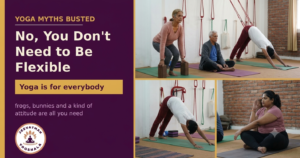
No. Flexibility is an outcome of practice, not a prerequisite for it. A good teacher training spends far more time on alignment, anatomy, breath, sequencing, philosophy and how to safely instruct other bodies than on how far any individual body bends.
There’s a practical argument here too, and it’s the one that convinces people: the teachers who are best at helping stiff students are the ones who were stiff themselves. If you can already fold flat, you have no idea what it feels like when someone can’t. That’s a teaching disadvantage, not an advantage.
Can you do a teacher training if you can’t do a headstand?
Yes. Inversions are a small part of a 200-hour syllabus and are always taught with progressions and wall support. Nobody is required to invert. If you have high blood pressure, glaucoma, a neck injury or you’re pregnant, you shouldn’t be inverting anyway, and any competent teacher will give you an alternative rather than push you.
The same applies to arm balances, deep backbends and the lotus position. Tell your teachers on day one what your body does and doesn’t do.
The three things that actually predict whether you’ll cope
Not flexibility. These:
- Baseline stamina. A residential course means roughly four to six hours of activity a day for three weeks, starting before sunrise. That’s a cardiovascular and recovery question, not a flexibility one. If you can walk briskly for an hour without difficulty, you’re fine.
- Tolerance for being a beginner in public. You will teach a class to your peers in week three. Some people find that harder than any physical demand in the course.
- Willingness to sit still. Meditation, pranayama and philosophy are a substantial part of the syllabus. For a lot of physically fit students, the hardest hour of the day is the one where nothing happens.
How to prepare in the three months before you fly
- Practise three times a week, minimum. Consistency beats intensity. Two 45-minute sessions and one longer one is plenty.
- Include one Hatha and one Vinyasa class weekly if you can. Our 200-hour training is multi-style, combining Hatha fundamentals with Ashtanga Vinyasa. Exposure to both removes the surprise. If you’re unsure which is which, read Hatha vs Ashtanga.
- Start sitting. Five minutes of stillness daily, building to fifteen. This is the single most useful preparation nobody does.
- Walk more. Rishikesh is hills, steps and uneven lanes before you even get to the shala.
- Read one book. A plain-language translation of the Yoga Sutras. Philosophy sessions land very differently when the framework isn’t brand new.
- Sort the logistics early so you arrive calm — visa, month, and what to pack.
Am I too old to do a yoga teacher training?
Groups in Rishikesh routinely run from early twenties to late sixties. Age changes what you modify, not whether you can train. Older students frequently do better on the theory, anatomy and teaching-methodology components, and they tend to be more careful with their bodies — which makes them safer teachers.
If you’re over 50 and new to yoga, build the three-month base first and tell your teachers about any joint replacements, osteoporosis or cardiac history on day one.
What about injuries, or being overweight?
Neither disqualifies you. Both change how you should be taught.
Declare it before you book, in writing, and ask specifically: how will you modify for this? A school that answers with real detail — props, alternative poses, which sessions you’d sit out — is a school worth training with. A school that says “no problem, everyone can do yoga” without asking a single follow-up question hasn’t thought about it, and that’s the answer you’re actually testing for.
Serious cardiac conditions, uncontrolled blood pressure, recent surgery or an acute spinal injury are a genuine “talk to your doctor first” category. Get medical clearance, then talk to the school.
Who should wait
Being honest about this matters more than filling a course:
- You’ve never practised yoga at all and you fly in six weeks. Move to a later batch and build a base. You’ll get far more from the same money.
- You’re in an acute injury or illness phase. Recover, then train.
- You want a holiday. This isn’t one. It’s a 22-day course with early mornings, homework and an exam. Our yoga retreats exist for the other thing, and there’s no shame in choosing that instead.
- Someone else wants this for you. The people who struggle most are the ones who didn’t choose it.
What the first week is actually like for a beginner
Days one to three: everything aches, you sleep badly, the 6am bell feels personal, and you wonder what you’ve done. This is universal and it is not a signal about your ability.
Days four to seven: your body recalibrates. You stop thinking about whether you can keep up and start noticing what your teachers are actually saying about alignment. This is where the training really starts.
By week two the physical question has usually disappeared entirely and been replaced by the real one — can I explain this to someone else? Our hour-by-hour daily schedule shows how the days are structured, and the first-timer’s guide covers the wider experience.
Do you have to teach afterwards?
No, and a large share of every group never intends to. People take a 200-hour training to deepen their own practice, to take a structured break from work, or because they want to understand the philosophy behind something they’ve done for years. The certificate doesn’t obligate you to anything.
If you do want to teach, registering as an RYT 200 with Yoga Alliance is the usual next step, and — per the standards above — it requires no teaching hours at all.
Frequently asked questions
Can a complete beginner do a 200-hour yoga teacher training?
Yes. Yoga Alliance requires no prior practice experience, no teaching hours and no flexibility standard for a 200-hour training. Three months of consistent practice beforehand will let you learn rather than just survive, but it isn’t a formal requirement.
How much yoga experience do I need before a teacher training?
There is no official minimum. In practice, six months of practising two to three times a week puts you comfortably in the middle of a typical Rishikesh group. Less than that is workable; none at all is hard.
Do I need to be flexible to do a yoga teacher training?
No. Flexibility is a result of practice, not a requirement for it. Teacher training focuses on alignment, anatomy, breath, sequencing and teaching methodology. Teachers who were once stiff are usually better at helping stiff students.
Can I do a 200-hour yoga teacher training if I can’t do a headstand?
Yes. Inversions are a small part of the syllabus and are always taught with progressions and wall support. Nobody is required to invert, and several medical conditions make inversions inadvisable regardless of ability.
Am I too old for a yoga teacher training?
Groups routinely span the early twenties to the late sixties. Age changes what you modify, not whether you can train. Older students often perform better on anatomy, philosophy and teaching methodology.
Can I do a yoga teacher training with an injury?
Usually yes, with modifications. Declare it in writing before booking and ask the school exactly how they would adapt sessions. A detailed answer is a good sign; “everyone can do yoga” without follow-up questions is not.
Do I have to teach after a 200-hour training?
No. Many students train to deepen their own practice rather than to teach. The certificate creates no obligation, and registering with Yoga Alliance afterwards is optional.
Start where you actually are
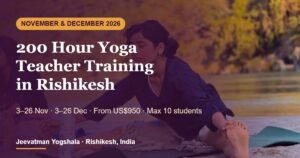
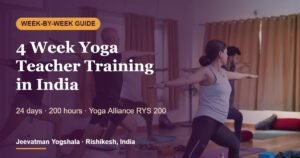
Our 200-hour Yoga Teacher Training in Rishikesh runs from the 3rd to the 26th of every month, from $899, and takes beginners as well as experienced practitioners in a multi-style Hatha and Ashtanga Vinyasa syllabus. Full fees for every programme are on the course fees page.
Not sure you’re ready? Tell us honestly where your practice is — including any injuries — and we’ll tell you straight whether to book now or build a base first. If a shorter introduction suits you better, the 100-hour course is a lower-commitment starting point.