Last updated: November 2026 · Jeevatman Yogshala, Swargashram, Rishikesh
Quick answer: Most aerial yoga teacher trainings in India are 50-hour courses that run for 6–7 days, and most are in Rishikesh. Published fees we checked in November 2026 run from about ₹18,000 to US$650, depending on accommodation. A 50-hour aerial certificate is a specialty qualification: it trains you to teach safe, beginner-level aerial classes. It works best on top of a 200-hour yoga foundation, and it doesn’t make you a rigging installer.
Key facts at Jeevatman Yogshala (November 2026):
- 50-hour Aerial Yoga TTC: 6 days, US$350 without accommodation or US$450 with it (₹25,900 / ₹34,000 for Indian students)
- 50-hour Aerial Yoga TTC with Sound Healing: 6 days, US$450 or US$550
- No aerial experience needed, maximum 15 students, monthly batches from the 18th to the 23rd
What is an aerial yoga teacher training?
Aerial yoga uses a soft fabric hammock hung from the ceiling to support yoga postures, inversions and flowing sequences. An aerial yoga teacher training shows you how to practise it safely and how to teach it: hammock height and knots, warm-ups, progressions, cueing, spotting, and safe ways in and out of inversions.
It is not a general yoga teacher training. You’ll spend most of the course in the hammock, with less time on philosophy and anatomy than on a 200-hour course.
Aerial yoga teacher training fees in India
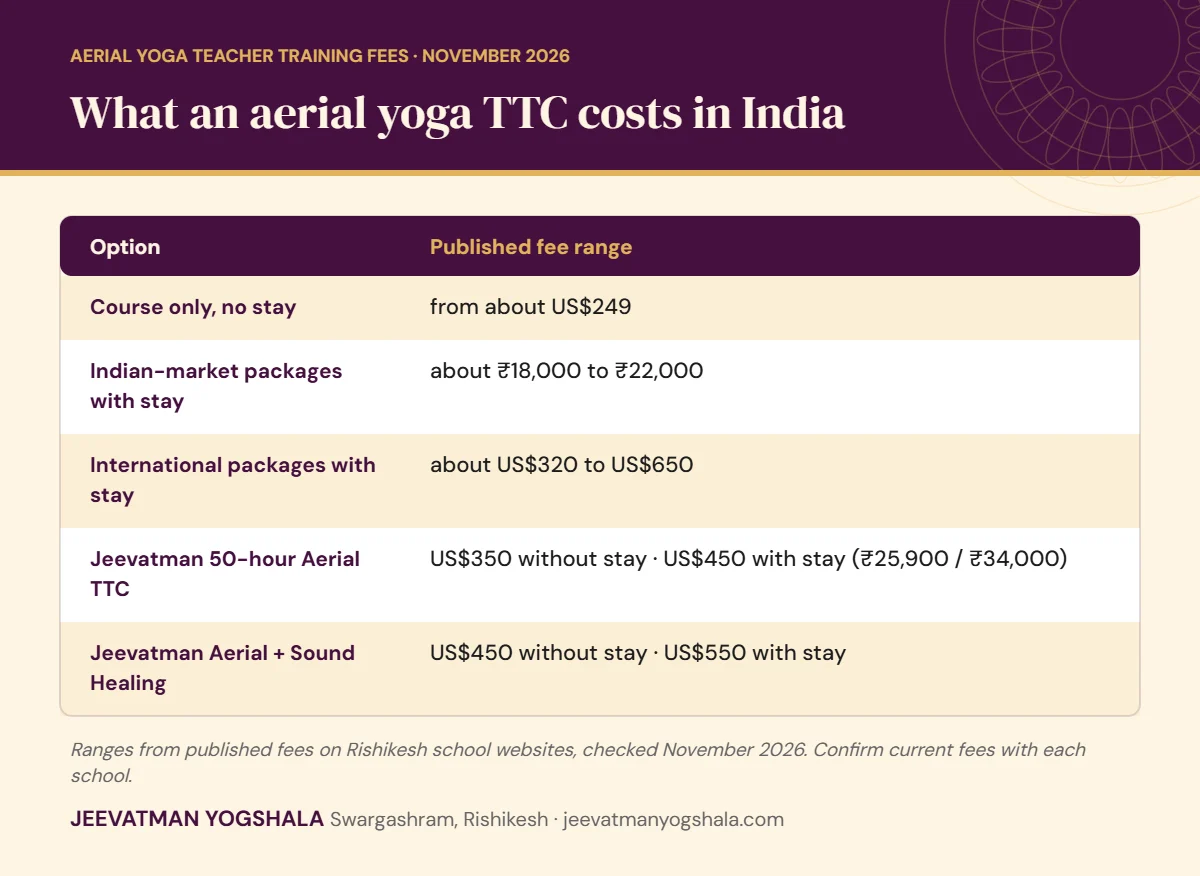
| Option | Published fee range (Nov 2026) |
|---|---|
| Course only, no accommodation | from about US$249 |
| Indian-market packages with accommodation | about ₹18,000 to ₹22,000 |
| International packages with accommodation | about US$320 to US$650 |
| Jeevatman: aerial only | US$350 without stay / US$450 with stay |
| Jeevatman: aerial + sound healing | US$450 without stay / US$550 with stay |
Ranges come from published aerial yoga teacher training fees on Rishikesh school websites checked in November 2026. Some show discounted prices beside a higher list price. Confirm current fees with each school.
We’re not the cheapest aerial course in Rishikesh, and we don’t try to be. What the fee pays for is a batch of no more than 10 students, a daily schedule that keeps pranayama and meditation alongside the aerial work, and the option to add a sound healing certificate in the same 6 days.
What the certificate covers, and what it doesn’t
It covers: teaching beginner and mixed-level aerial classes with safe progressions, knots and height adjustment, aerial warm-ups, backbends, splits and basic inversions, and how to cue and spot students.
It doesn’t cover:
- Rigging. Installing ceiling points, beams or frames is a structural job for a qualified professional. A yoga course teaches you to check a rig, not to build one.
- A general yoga teaching credential. Many studios that hire aerial teachers also ask for a 200-hour yoga certificate. If you don’t have one yet, see our 200-hour yoga teacher training.
- Advanced drops on day one of teaching. You’ll learn them on the course, but you should practise them for a long time before teaching them.
Do you need yoga experience to join?
No aerial experience is needed to join an aerial yoga teacher training, and no formal qualification. You’ll get far more from the six days if you can already hold a plank, hang briefly by your hands and practise for two sessions a day. If you’re new to the hammock, try a few aerial classes first or read how to start aerial yoga.
Who should not do aerial yoga
Inversions put pressure on the head, eyes and heart. Speak to your doctor before booking, and tell us before you arrive, if any of these apply to you:
- pregnancy
- glaucoma or other serious eye conditions
- high or low blood pressure, or a heart condition
- recent surgery, a recent head injury, or vertigo
This list is general guidance, not medical advice.
Day by day: the 50-hour aerial yoga TTC at Jeevatman
- Day 1, foundations: how to tie knots and set the hammock height, shoulder strength and stretches, and first poses such as supported child’s pose, superman and chair pose.
- Day 2, core and basics: core strength, goddess, tree, floating boat (navasana), eagle pose and aerial sun salutations.
- Day 3, legs and hips: butterfly variations, side splits, hanumanasana, pigeon, standing splits, vishwamitrasana and warrior A and B.
- Day 4, backbends: bridge and wheel variations, bow, full pigeon (raja kapotasana), locust, natarajasana, with forward-bend counter poses.
- Day 5, inversions: inverted butterfly, handstand, ankle hang, batman, vampire and vampire flip, shoulder stand and first drops.
- Day 6, advanced work and revision: advanced asanas, teaching practice and a full review.
A typical day
| Time | Activity |
|---|---|
| 6:30–8:00 AM | Pranayama and mantra chanting |
| 8:30–10:00 AM | Asana practice |
| 10:15 AM | Brunch, free time and study |
| 12:15–1:00 PM | Yoga nidra meditation |
| 3:00–4:00 PM | Teaching practice and revision |
| 4:30–6:15 PM | Aerial asana practice |
| 6:30–7:30 PM | Dinner |
| 8:00–8:45 PM | Meditation or kirtan |
| 9:00 PM | Mauna (silence) |
Is 50 hours enough to teach aerial yoga?
A 50-hour aerial yoga teacher training is enough to start teaching beginner classes if you keep practising after the course. It isn’t enough to teach advanced drops and flips to beginners straight away.
The graduates who teach well usually do three things after the course: they practise the full beginner sequence until they can cue it without notes, they co-teach or assist a few classes before leading their own, and they teach small groups first. A 50-hour certificate opens the door. Your own hours in the hammock decide how quickly you walk through it.
Aerial only, or aerial with sound healing?
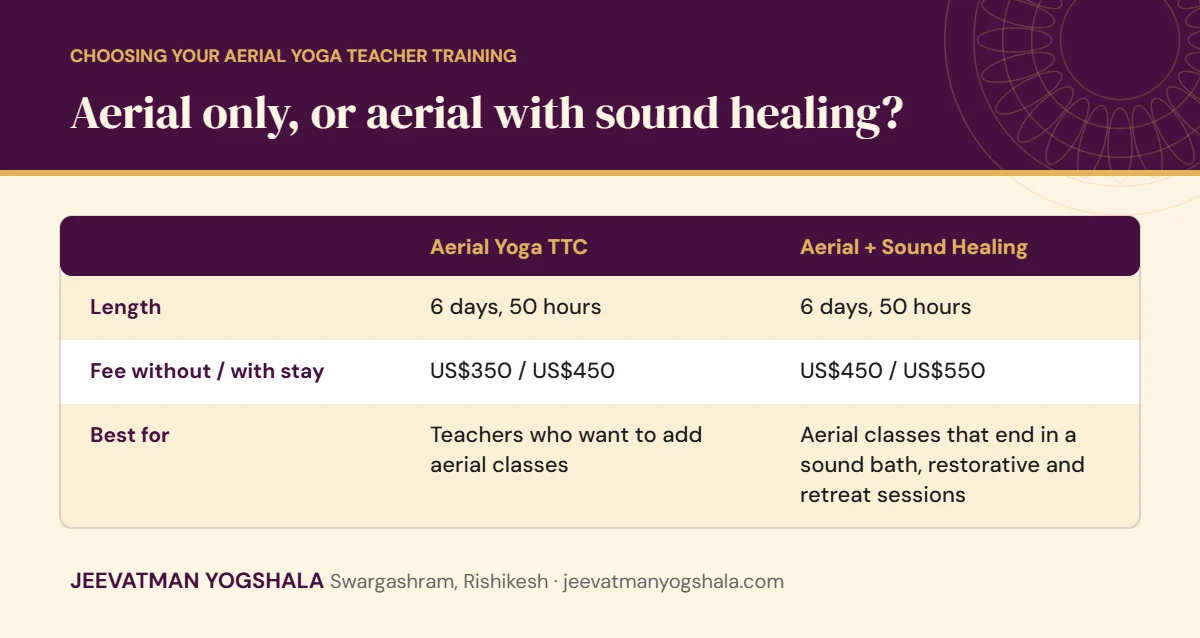
| Aerial Yoga TTC | Aerial + Sound Healing TTC | |
|---|---|---|
| Length | 6 days, 50 hours | 6 days, 50 hours |
| Fee without / with stay | US$350 / US$450 | US$450 / US$550 |
| Best for | Teachers who want to add aerial classes | Teachers who want to run aerial classes that end with a sound bath, or restorative and retreat sessions |
See the Aerial Yoga TTC and the Aerial Yoga TTC with Sound Healing.
8 questions to ask any aerial yoga school before you pay
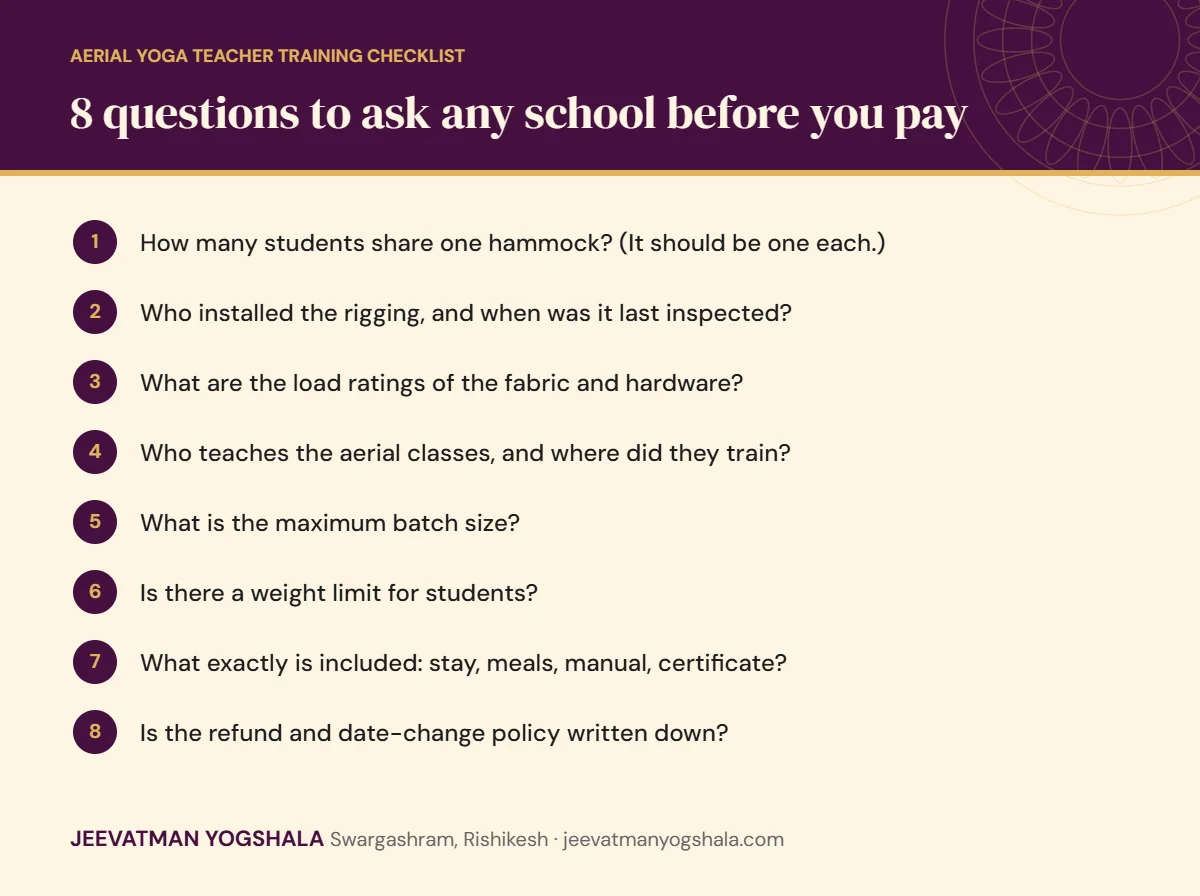
- How many students share one hammock? (The answer should be one each.)
- Who installed the rigging, and when was it last inspected?
- What are the load ratings of the fabric and hardware?
- Who teaches the aerial classes, and where did they train in aerial yoga?
- What is the maximum batch size?
- Is there a weight limit for students?
- What exactly is included: stay, meals, manual, certificate?
- Is the refund and date-change policy written down?
After the course: setting up to teach
- Fabric: use low-stretch nylon tricot made for aerial yoga, not decorative fabric.
- Hardware: use carabiners, swivels and daisy chains that are load-rated for people, never hardware-store hooks.
- Rigging: have every ceiling point or frame installed and checked by a qualified rigging or structural professional.
- Insurance: check that your teaching insurance names aerial yoga specifically. Many standard yoga policies don’t.
Upcoming batches
18–23 December 2026 · 18–23 January 2027 · 18–23 February 2027 · 18–23 March 2027 · 18–23 April 2027 · 18–23 May 2027
The best months for weather are usually October to April. Here’s our guide to the best time for yoga teacher training in Rishikesh, and what to pack.
Check your fit before you book: message us on WhatsApp with your preferred month, your yoga or fitness background, and whether you want to add sound healing. We reply within 2 hours (9 AM–9 PM IST).
How to book your aerial yoga teacher training
- Pick a batch. Courses run from the 18th to the 23rd of each month, with a maximum of 10 students, so the October to April months fill first.
- Message us before you pay. Send us your preferred month and your yoga or fitness background on WhatsApp. We’ll tell you honestly whether the course suits you and whether a seat is free.
- Choose aerial only or aerial with sound healing. If you also want to lead sound baths, read our guide to sound healing certification in India first.
- Sort your visa and travel. Our visa guide for yoga teacher training in India covers which visa to apply for.
- Arrive a day early. Plan to reach Rishikesh at least a day before the course starts, so you are rested for the first session in the hammock.
New to yoga altogether? An aerial yoga teacher training works best on top of a 200-hour foundation. Compare the 100 hour vs 200 hour yoga teacher training before you decide, or see the full aerial yoga TTC with sound healing course page.
Frequently asked questions
How long is an aerial yoga teacher training?
Most aerial yoga teacher training courses in India are 50 hours over 6–7 days. At Jeevatman Yogshala it runs for 6 days, from the 18th to the 23rd of each month.
How much does aerial yoga teacher training cost in India?
Published aerial yoga teacher training fees checked in November 2026 run from about ₹18,000 to US$650. At Jeevatman Yogshala it costs US$350 without accommodation or US$450 with accommodation.
Can a beginner do an aerial yoga teacher training?
Yes. No aerial experience is required for an aerial yoga teacher training, but basic strength and fitness make the six days much easier.
Is aerial yoga certification recognised internationally?
Yoga teaching isn’t licensed by governments in most countries. Studios judge aerial teachers on their certificate, their base yoga training and a demo class. A 200-hour yoga certificate plus an aerial certificate is a combination many studios ask for.
Who should avoid aerial yoga?
People who are pregnant, or who have glaucoma, high or low blood pressure, a heart condition, vertigo, recent surgery or a recent head injury, should check with a doctor first.