Before booking a 200 hour yoga teacher training in Rishikesh, most people want to know one thing: what does the day actually look like? Not the brochure version, the real one. The 5: 30am wake-up, the two-a-day practices, the philosophy classes, the evenings, the rest day. All of it.
Below is the exact daily time table from Jeevatman Yogshala’s 200 hour YTT. With honest notes on what each block actually feels like, especially in the early days when the body is adjusting.
The Jeevatman 200 Hour YTT - Daily Timetable
| Time | Activity | What to Expect |
|---|---|---|
| 5:30 AM | Wake Up & Herbal Tea | This 10 minutes before the official day starts tea, silence, river sound, bells ringing, is something most graduate say they miss most when they return home. |
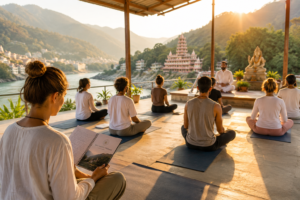
| 6:00 - 7:00 AM | Pranayam & Mantra Chanting | One hour of seated practice: body scan, pranayama (rotating daily through Nadi Shodhan, Kapalbhati, Bhastrika, Bhramari, Ujjayi), and 20 minutes of Mantra chanting. In week one this can feel uncomfortable. By week three, most students cannot imagine starting the day any other way. |
| 7:15 - 8:45 AM | Hatha Asana Practice | One and a half hour of guided asana led by a senior teacher. In weeks one and two the focus is foundational asana as standing poses, forward folds, basic backbends. By week three the practice deepens considerable into inversions, arm balances, and more complex sequencing. |
| 9:00 - 10:00 AM | Breakfast | Satvik vegetarian food. Fresh fruit, porridge, dal, roti, curd, muesli, etc. Cooked fresh each morning. The meal is part of the practice. No eggs, no meat. After about a week of eating this way, most students notice a shift in their energy and sleep quality. |
| 10:30 - 12:30 PM | Academic Session | Rotates daily across three subjects: Yoga Philosophy (Yoga Sutras, Bhagavad Gita, Samkhya), Anatomy and Physiology (practical, body-focused), and Teaching Methodology (sequencing, cueing, adjustments). Philosophy sessions are consistently the most unexpectedly alive part of the training. |
| 1:00 - 2:00 PM | Lunch | The largest meal of the day, followed by genuine rest time. Many students nap. Others journal or walk to the Ganga. This is integration time. The body and mind process the morning work. Do not skip the rest. The training requires it. |
| 4:00 - 5:30 PM | Ashtanga Vinyasa Asana Practice | Different in quality from the morning. Ashtanga Vinyasa is more alignment and breath focused practice. In 200 hour YTT we practice the primary series of Ashtanga Vinyasa. |
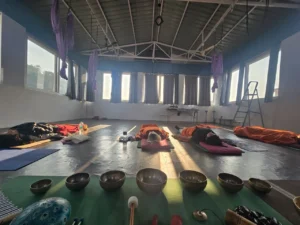
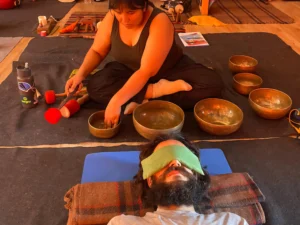
| 6:00 - 7:00 PM | Meditation / Kirtan / Sound Healing Session | Rotates across the month. Some evenings are Silent Meditations, some guided Yoga Nidras, some active Osho meditations, and some kirtan evenings with devotional chanting and harmonium. While over some weekend there are sound healing sessions arranged. |
| 7:00 - 8:00 PM | Dinner | Lighter than lunch. Soups, khichdi, sabji, roti, herbal teas. The dinner table atmosphere shifts noticeable across the month. By week three, conversations here go somewhere real. Philosophy, personal revelations, laughter. The particular warmth of a group that has stopped pretending. |
| 9:30 PM | Mauna / Rest / Lights Out Recommended | The school recommends being in bed by 9:30PM. In week one, some students resist this. By week two, most are asleep before 9:00PM without effort. The body realigns with natural rhythms. This is part of the practice. |
Honest Note
The schedule looks intense on paper. It is intense, but not in the way most people expect. The intensity is not punishing. It is the particular kind of full that happens when every hour of the day is genuinely purposeful. Most students report sleeping better than they have in years.
Is it Too Intense? An Honest Answer
Yes, it is intense in these ways
Two asana practices daily. Early mornings every day. Deep philosophy that surfaces real questions. Teaching in front of people. Being far from home in a completely different environment. Weeks two and three are the hardest for most students. Something usually breaks open.
No, it is not intense in these ways
You are never asked to perform beyond your capacity. The rest periods are real. Sundays are completely free. Modifications are built in. Experienced teachers know what week three looks like and hold it well. Nobody has to be anywhere near advanced to keep up.
The most honest thing we can say: almost no student finishes the month wishing it had been easier. Intensity is the point. Not as hardship but as the conditions under which real change becomes possible. A month of gentle yoga classes does not produce the same result.
How the Rhythm Changes Week by Week
Week 1 • Days 1 – 6
Adjustment
The body a just to the 5: 30am start, the food, the two-a-day practice. The asana focus is foundational. Philosophy begins with history and overview of the yoga sutras. No teaching practice yet. The group is still strangers. By day 5 or 6, the rhythm starts to feel natural rather than effortful.
Week 2 • Days 7- 13
Finding the Rhythm
Early morning stop being a battle. The practice deepens. Philosophy moves into the sutras and students start forming opinions about them. First teaching practice sessions begin. These are short segments, not full classes, but the feedback loop starts here. Group dynamic shiftss from polite to genuine.
Week 3 • Days 14 – 19
The Most Intense week
Universely the most challenging and the most profound. The body is working hard. Philosophy goes deeper into the nature of suffering and the roots of mental patterns. Teaching practice intensifies. Emotional processing is common. The teachers at Jeevatman have watched week three for years. They know how to hold it without making it dramatic.
Week 4 • Days 20 – 24
Integration
A different quality of light in this week. Students lead full classes. Philosophy turns toward how to carry everything into real life, not just into teaching but into how you actually live. The last few days are often marked by gratitude and the tenderness that is difficult to describe from outside. The graduation afternoon is something most students describe for months after returning home.
The Rest Day – Sunday
Sunday is a full day off. No classes, no schedule, no obligations. Most students use it to:
- Sleep – genuinely, deeply, as much as the body ask for
- Walk along the ghats of Maa Ganga and sit with the river
- Visit the temples at Ram Jhula or The Beatles ashram nearby
- Eat at a local cafe or try the thali at one of the small restaurants near the bridge
- Attend the Ganga Aarti ceremony at Triveni Ghat in the evening. One of the most moving things a visitor can witness in Rishikesh
- Simply sit in stillness and let the week settle
Sunday evenings often become the group’s most naturally social time. Going together to the river, sharing food, talking in a way the structured week does not always allow. These evenings are as much a part of the experience as the 6:00am practice sessions.
What Free Time Looks Like
Beyond Sundays, evenings from roughly 8:00pm onward are unstructured. The post lunch rest period is designated downtime. Within the training days there is room to breathe. This is not a closed program that forbids phone use or personal time.
Most students find that phone use naturally decreases as the month progresses. Not because it is prohibited, but because what is happening inside the training becomes more interesting than what is happening on a screen. Many describe the month as the longest they have ever gone without social media and are surprised by how little they missed it.
.
What time does the day start at a 200 hour yoga teacher training in Rishikesh?
At Jeevatman Yogshala, the day begins at 5:30am with tea and personal preparation, moving into the formal pranayama session at 6:00am. The early start is intentional. Pre-dawn hours are considered in the yogic tradition the most auspicious time for practice, and the quality of silence in Rishikesh at this hour is unlike any other time of day.
Is the schedule same every day?
The time blocks remain consistent, but the content rotates. The academic session rotates daily between philosophy, anatomy, and teaching methodology. The evening session rotates between guided meditations, kirtans and sound healing session. The variation prevents the routine from becoming mechanical.
Is there a day off during the 200 hour yoga teacher training?
Yes, Sunday is a complete rest day with no scheduled classes or sessions. It is entirely free time for students to sleep, explore Rishikesh, visit Maa Ganga or simply rest. This rest day is built into the programme intentionally. The body and nervous system need genuine recovery time during and intensive residential training.
How many hours of yoga practice are there per day?
Approximately 3 hours of asana, 1 hour of meditation, and 1 hour of pranayama practice daily. This is in addition to academic sessions (philosophy, anatomy, teaching methodology) of approximately 2 hours per day.
What if I cannot keep up with the schedule physically?
Modifications are available for every practice, and students are never required to push beyond their comfortable range. The emphasis throughout is on consistency and sincerity, not performance. If you need to rest a session due to fatigue or minor illness, that is accommodated without penalty. The teachers at Jeevatman have extensive experience supporting students at different physical levels through the same intensive programme.
Can I leave the school during the training?
Yes. Outside of scheduled sessions, students are free to move around Rishikesh. Evenings and the post-lunch rest period a personal time. Rishikesh itself - the ghats, the temples, the local markets, the cafes are fully accessible throughout the training. The school is not a closed environment.
How does week three feel different from week one?
Very different. Week one is adjustment. The body is stiff, the early mornings are a discipline, everything is new. Week 3 is where most students hit the deepest challenge and the deepest opening simultaneously. The practice has built enough momentum to start dislodging what the body and mind have been carrying. It is the hardest week and, almost universally, the most transformative. Experienced teachers hold this week with particular care.
Experience This Schedule In Rishikesh
200 Hour Yoga Teacher Training at Jeevatman Yogshala
• Jonk Village, Ram Jhula, Rishikesh • Yoga Alliance Certified • Batches of 12-15
• Sound Healing Included • New Batches Every month