Stylish Running Offer
🚀 Limited early bird seats – Grab 15% Off Now! Contact Now

Chandra Namaskar: The Ancient Yogic ‘Coolant’ for Your  Mind and Body

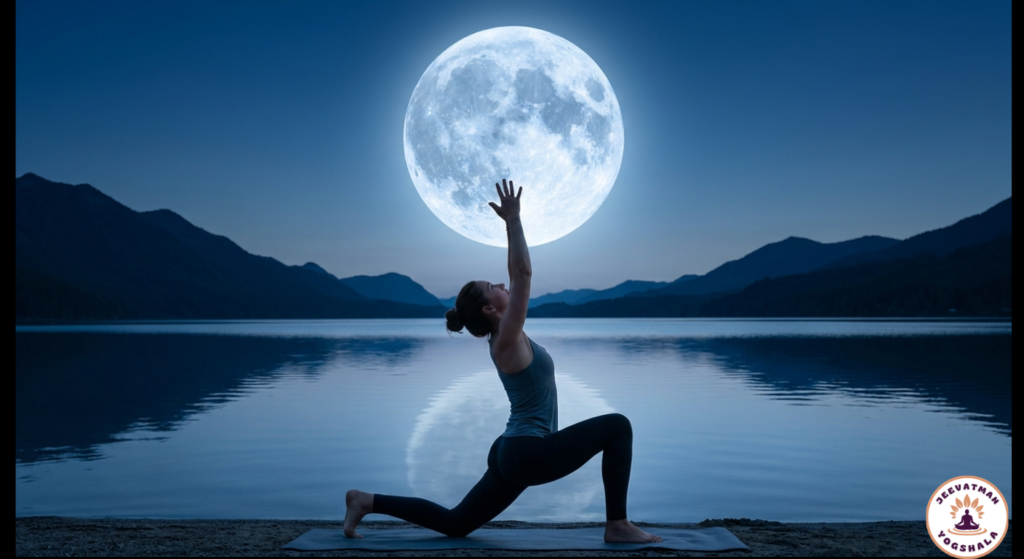
Chandra Namaskar Under the Moonlight

Some days just feel like too much—the noise, the rush, the constant stimulation around you. Your mind feels overheated, your body tense, and no amount of scrolling or sleeping seems to fix it.

Your body is exhausted—but your thoughts are still running.

It’s strange, isn’t it? How we are constantly told to do more, move faster, push harder

…but rarely taught how to slow down.

In moments like these, Chandra Namaskar offers something rare: calmness.

Unlike the more popular Surya Namaskar, which energizes and heats the body, Chandra Namaskar—or the Moon Salutation—is a deeply calming, cooling yoga sequence designed to slow you down, both physically and mentally.

And honestly, most of us could use more of this right now.

What is Chandra Namaskar?

Most people describe Chandra Namaskar as the “moon version” of Surya Namaskar—and while that’s technically correct, it doesn’t fully capture what it feels like.

Chandra Namaskar is a traditional yoga sequence inspired by the moon’s gentle, soothing energy. While Surya Namaskar is associated with action, heat, and stimulation, Moon Salutation yoga is all about coolness, introspection, and emotional balance.

This isn’t just a sequence of poses. It’s slower, softer, and almost meditative in the way it flows.

Unlike fast-paced flows, moon salutation yoga invites you to move with awareness, similar to other mindful practices that focus on breath and presence. There’s no rush to reach the next pose. No pressure to perfect anything.

You simply move, breathe, and… gradually settle.

In yogic philosophy, the moon is connected to what’s called the Ida Nadi—the energy linked with calmness, intuition, and emotional balance. Practicing Chandra Namaskar helps activate this subtle energy, bringing balance to your internal system.

Chandra Namaskar vs Surya Namaskar

Before going deeper, it is important to understand how Chandra Namaskar differs from Surya Namaskar.
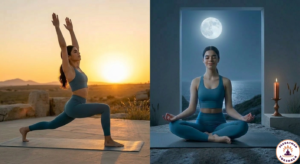
Surya Namaskar vs Chandra Namaskar Comparison

Aspect

Surya Namaskar

Chandra Namaskar

Energy

Heating

Cooling

Pace

Fast

Slow & fluid

Best Time

Morning

Evening/Night

Focus

Strength & stamina

Relaxation & balance

In simple words, Surya Namaskar energizes you, while Chandra Namaskar calms you.

Both have their place. But if your body already feels tense or overstimulated, adding more intensity is not always helpful. That’s where Chandra Namaskar becomes relevant.

Benefits of Chandra Namaskar

Let’s be real—most of us are already overstimulated.

Between caffeine, stress, screen time, and constant hustle, our nervous system is always in “go mode.

That’s why something like Chandra Namaskar can feel surprisingly relieving.

Here’s what consistent practice can do:

  1. Calms the Mind Instantly

If your thoughts don’t seem to slow down, this practice can help ease that.The slow transitions and mindful breathing activate your parasympathetic nervous system which is known to promote relaxation.

  1. Reduces Anxiety and Stress

Chandra Namaskar for anxiety and stress relief works beautifully because it combines movement with breath awareness—two powerful tools for emotional regulation.

  1. Balances Hormones

The gentle nature of the sequence makes it ideal for hormonal balance, especially for women.

  1. Improves Sleep

Practicing Chandra Namaskar in the evening can help your body unwind, making it easier to fall asleep naturally.

  1. Encourages Mindfulness

Unlike fast-paced workouts, this practice forces you to slow down and be present.

The slow, mindful movements in Chandra Namaskar help calm the mind and improve emotional balance, and research has also shown that regular yoga practice can reduce stress and enhance focus.

When is the best time to practice Chandra Namaskar?

Traditionally, Chandra Namaskar is practiced in the evening—or even under the moonlight.

But let’s keep it real.You don’t need a perfect setup.Even a quiet corner of your room, after a long day, is enough.

The real idea is simple: Practice it when your body needs to unwind.

For many people, that’s:

  • after sunset
  • before going to bed
  • or during moments of emotional overwhelm

Even 10–15 minutes of Chandra Namaskar at night can completely shift how you feel.

How to Practice the Moon Salutation – Chandra Namaskar Sequence

Let’s break down the Chandra Namaskar steps in a way that feels easy and doable.

Tip: Move slowly. This is not a race.
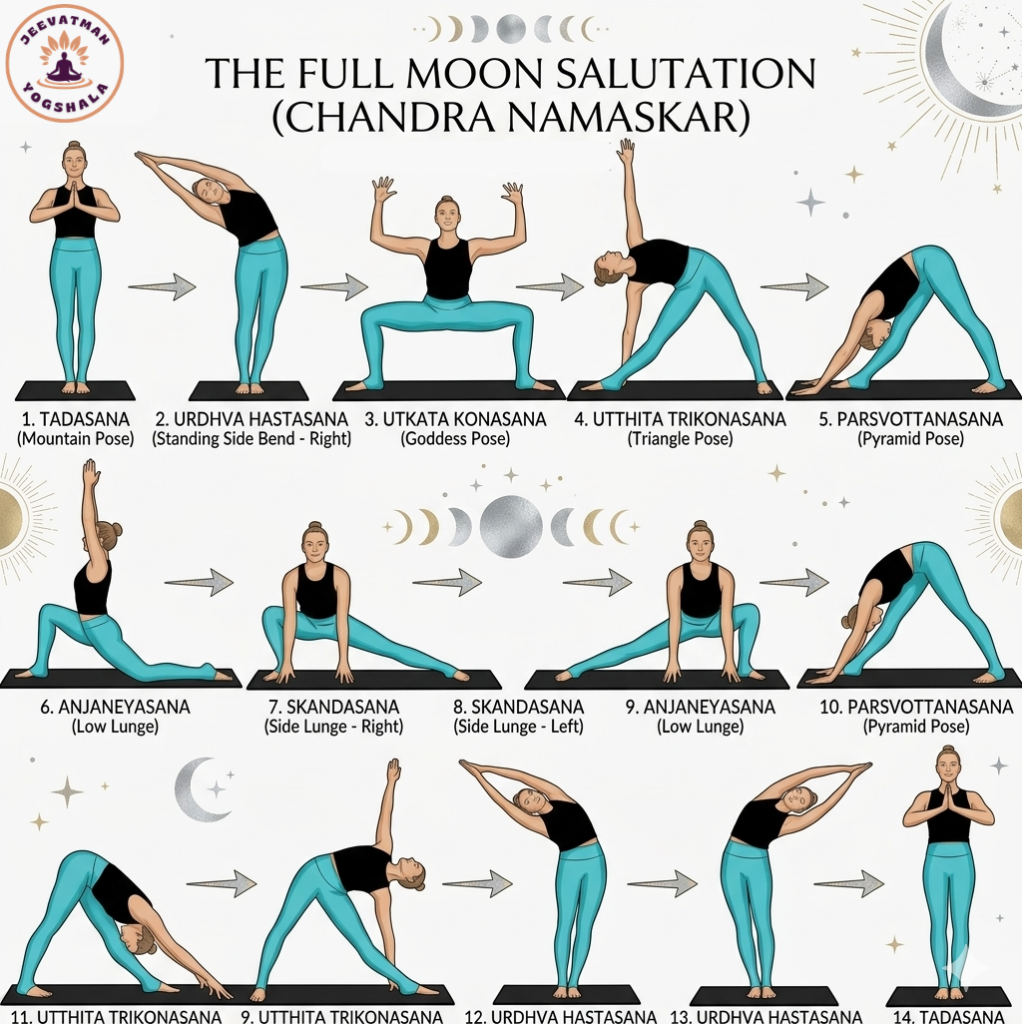
Chandra Namaskar Step-by-Step Sequence

Step-by-Step Flow:

  1. Tadasana (Mountain Pose / Prayer Position)

Begin by standing tall with your feet grounded. Bring your hands together in front of your chest in a prayer position (Namaste), allowing your body and breath to settle.

  1. Urdhva Hastasana (Standing Side Bend)

Inhale and raise your arms overhead. Gently bend your upper body towards the right side first, creating a soft stretch along the left side of your body.

  1. Utkata Konasana (Goddess Pose)

Step your feet wide apart and turn your toes slightly outward. Bend your knees and lower into a grounded squat, keeping your spine upright and arms open.

  1. Utthita Trikonasana (Triangle Pose)

Straighten one leg and extend your body sideways, reaching one hand down toward your foot while the other arm extends upward. Keep the movement controlled and steady.

  1. Parsvottanasana (Pyramid Pose)

Turn towards the extended leg and gently fold forward over it. Keep your spine long and avoid forcing the stretch.

  1. Anjaneyasana (Low Lunge)

Step one leg back into a low lunge, lowering your back knee. Open your chest slightly and keep your gaze soft and forward.

  1. Skandasana (Side Lunge)

Shift your weight to one side, bending one knee while the other leg stays extended. This creates a deep stretch through the inner thighs.

  1. Skandasana on the Other Side

Slowly shift your weight to the opposite side, maintaining control and balance as you move.

  1. Repeat on the Other Side

Return to the center and repeat the entire sequence on the left side, starting again with the side bend.

This completes one round of Chandra Namaskar sequence.This side-to-side pattern is what makes Chandra Namaskar different from linear sequences like Surya Namaskar.

Do 4–6 rounds for a complete session.

If you’re a beginner, start with 2–3 rounds and gradually increase.

Chandra Namaskar for Beginners

If you’re just starting out, don’t overcomplicate it.

Beginner Tips:

  • Move slowly—slower than you think
  • Focus on breathing, not perfection
  • Start with 2–3 rounds
  • Practice in silence or soft music

You don’t need flexibility or prior experience. Just a willingness to slow down a little.

You can also look onto our blog of “Yoga for beginners” if you wish to look onto other yoga poses other than Chandra Namaskar

Creating a Beautiful Evening Yoga Routine

One of the most beautiful things about Chandra Namaskar is that it fits effortlessly into your night routine.
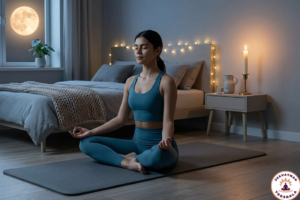
Chandra Namaskar Night Meditation for Calm Mind

You don’t really have to ‘make time’ for it—you can simply replace scrolling or overthinking with something more grounding.A simple evening yoga routine could look like this:

  1. 2 minutes deep breathing
  2. 4–6 rounds of Chandra Namaskar
  3. Gentle seated stretches
  4. 5 minutes meditation

This can become your daily ritual to unwind.
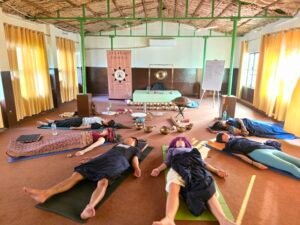
 

Common Mistakes to Avoid

Even though it’s a gentle practice, there are a few things to keep in mind:

❌ Rushing through the sequence

❌ Holding your breath

❌ Treating it like a workout instead of a flow

❌ Skipping relaxation at the end

Chandra Namaskar is not about achieving something. It’s about allowing something.

It simply gives your body space to relax and your mind a chance to slow down.

Integrating Chandra Namaskar Into Your Life 

In a world that constantly tells you to move faster, Chandra Namaskar quietly teaches you how to pause.

And sometimes, that pause is exactly what you need.

If Surya Namaskar is about rising and conquering the day, then Chandra Namaskar is about softening into yourself.

It’s for the nights when your mind won’t stop.
For the days when your energy feels drained.
For the moments when you just need a pause.

And the best part?
You don’t need anything fancy—just a little space, a few minutes, and your breath.

 Jeevatman Yogshala, a place for self-realization and transformation through the practice of yoga. Situated in the holy town of Rishikesh, Jeevatman Yogshala provides an enriching experience for yoga practitioners from across the world.

Grab 15% Off Now!
Get More Details:
Call / WhatsApp